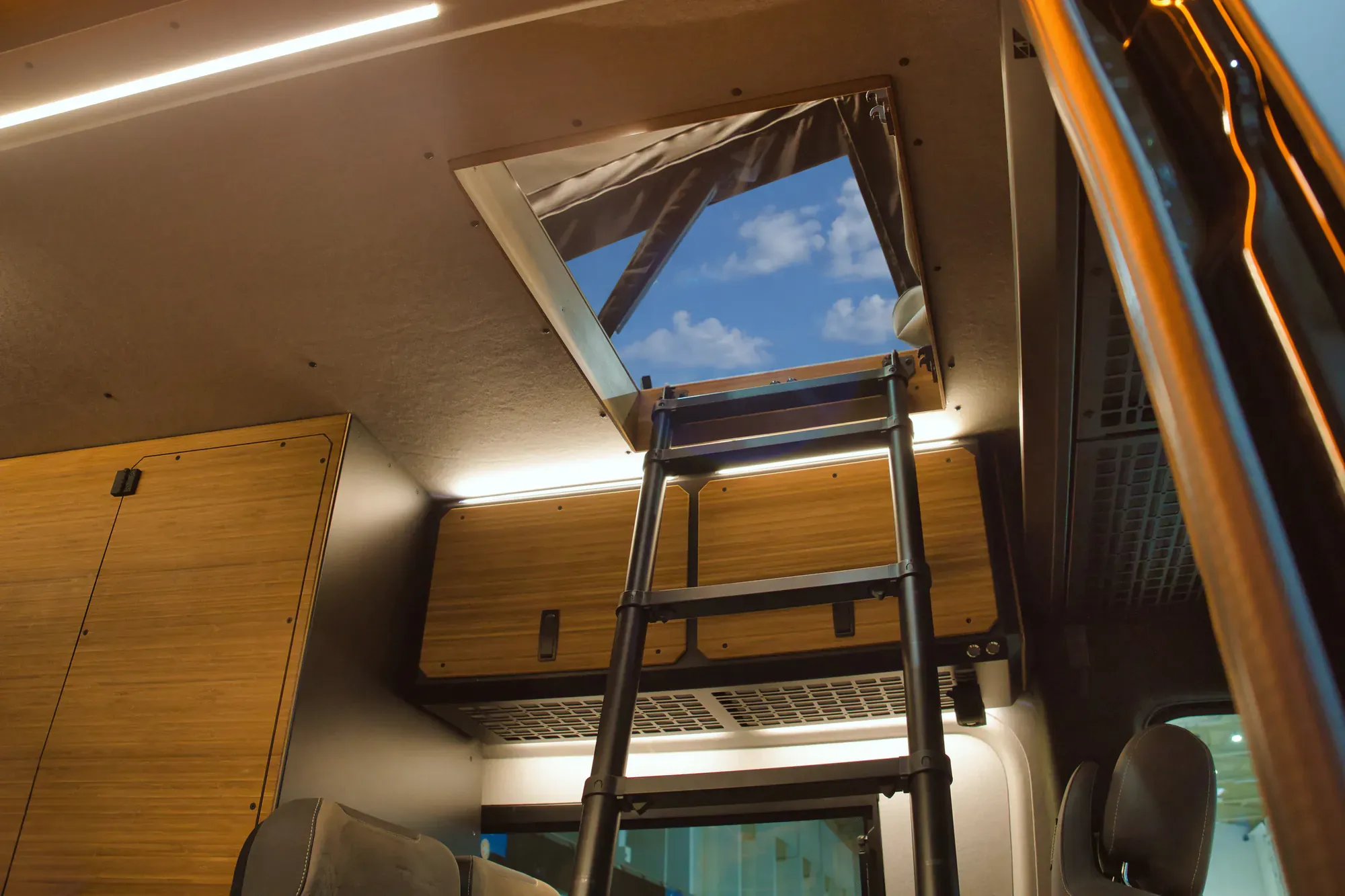
Step into the bedroom from inside.
A hatch connects the sleeping area with the van's interior and is included. Bamboo trim around the hatch is available exclusively in the VAN55 Horizon.
- Access from the interior
- Hatch included
VAN55 / pop-up sleeping roof for the Sprinter
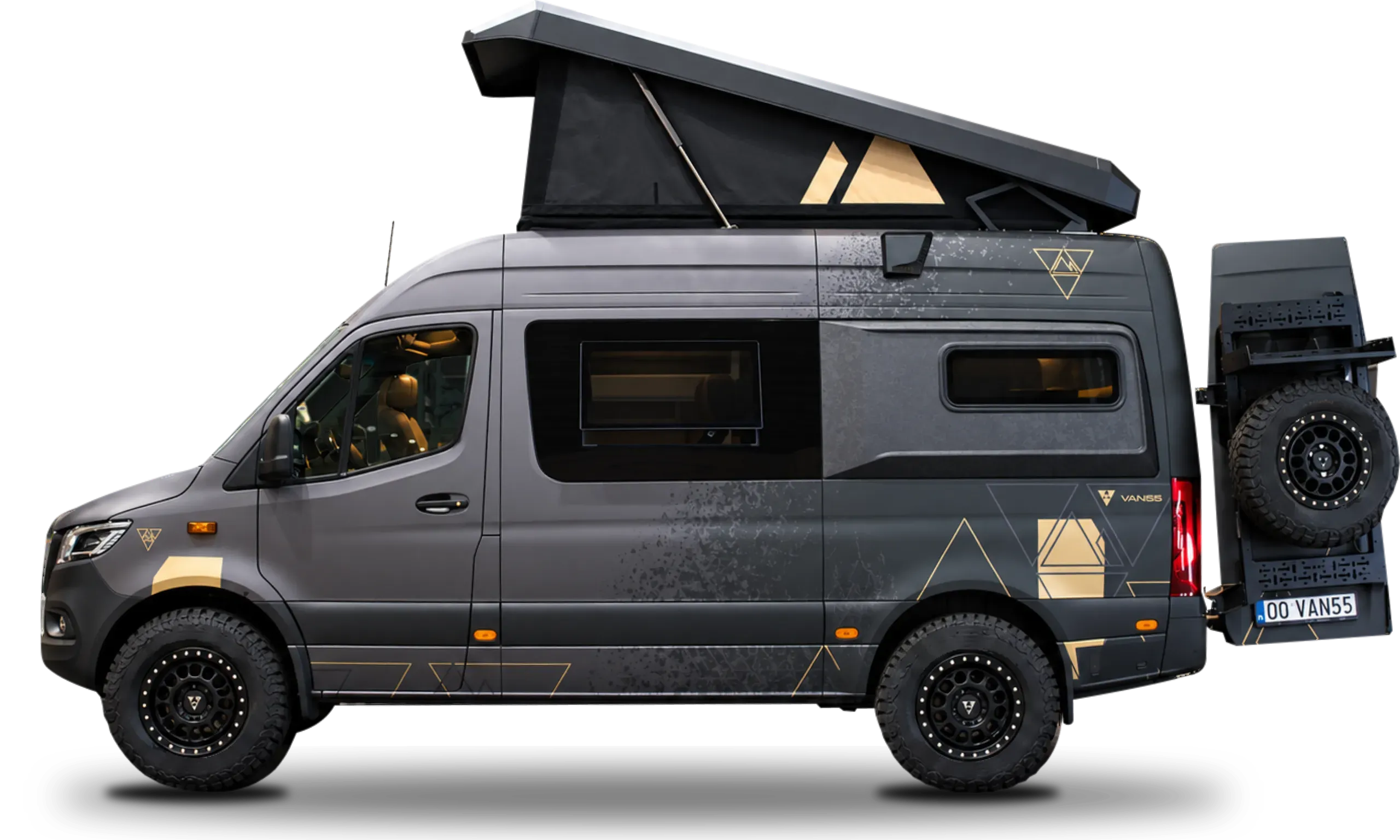 A new perspective on travel.
Price / two versions
The structure, mattress and fabric are identical in both versions. Only the lifting mechanism differs.
Gas struts, opened by hand
€8,012* gross
€6,514 net + 23% PL VAT
Electric actuators, push-button opening
€9,614* gross
€7,816 net + 23% PL VAT
Both versions: 125 × 210 cm mattress · Sunbrella fabric · ladder · LED lighting
Tent price, installation not included.
* Converted from PLN at the NBP rate of 22 Oct 2026 (1 EUR = 4.3685 PLN). The final price and VAT are confirmed in your quote.
01 / Bedroom and space
Generous headroom above the mattress and a vast bed ready for rest.
A hatch connects the sleeping area with the van's interior and is included. Bamboo trim around the hatch is available exclusively in the VAN55 Horizon.
Construction / VAN55
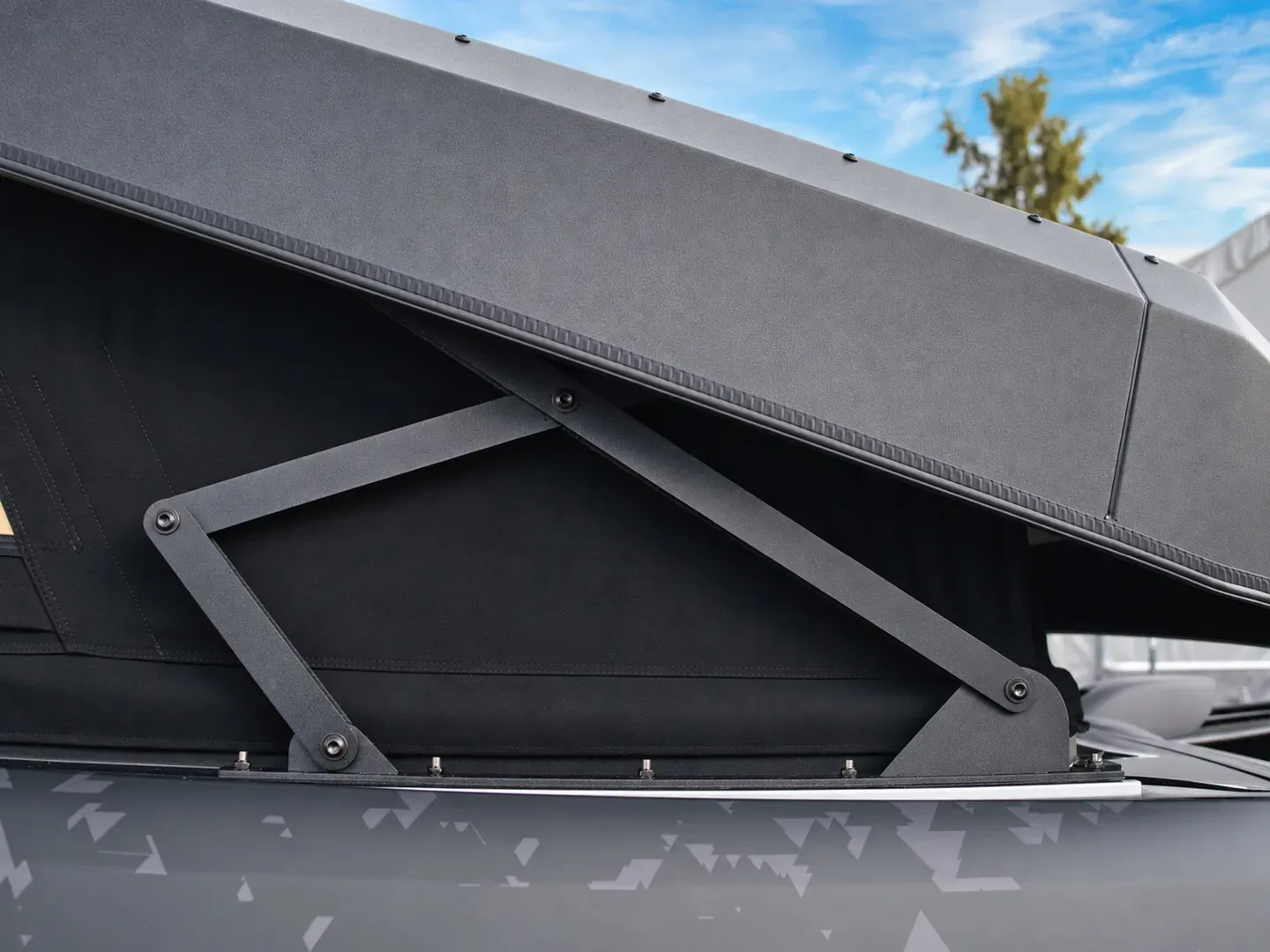
The rear scissor hinge lifts the roof at its rear edge too.
Plenty of room for your feet
In this example: less room above your feet
Illustrative comparison of design principles. Proportions are simplified and do not describe every roof with a pivot hinge.
The stainless-steel rear scissor hinge lifts the roof at its rear edge too, increasing the space above the mattress. It also gives the structure lateral stability.
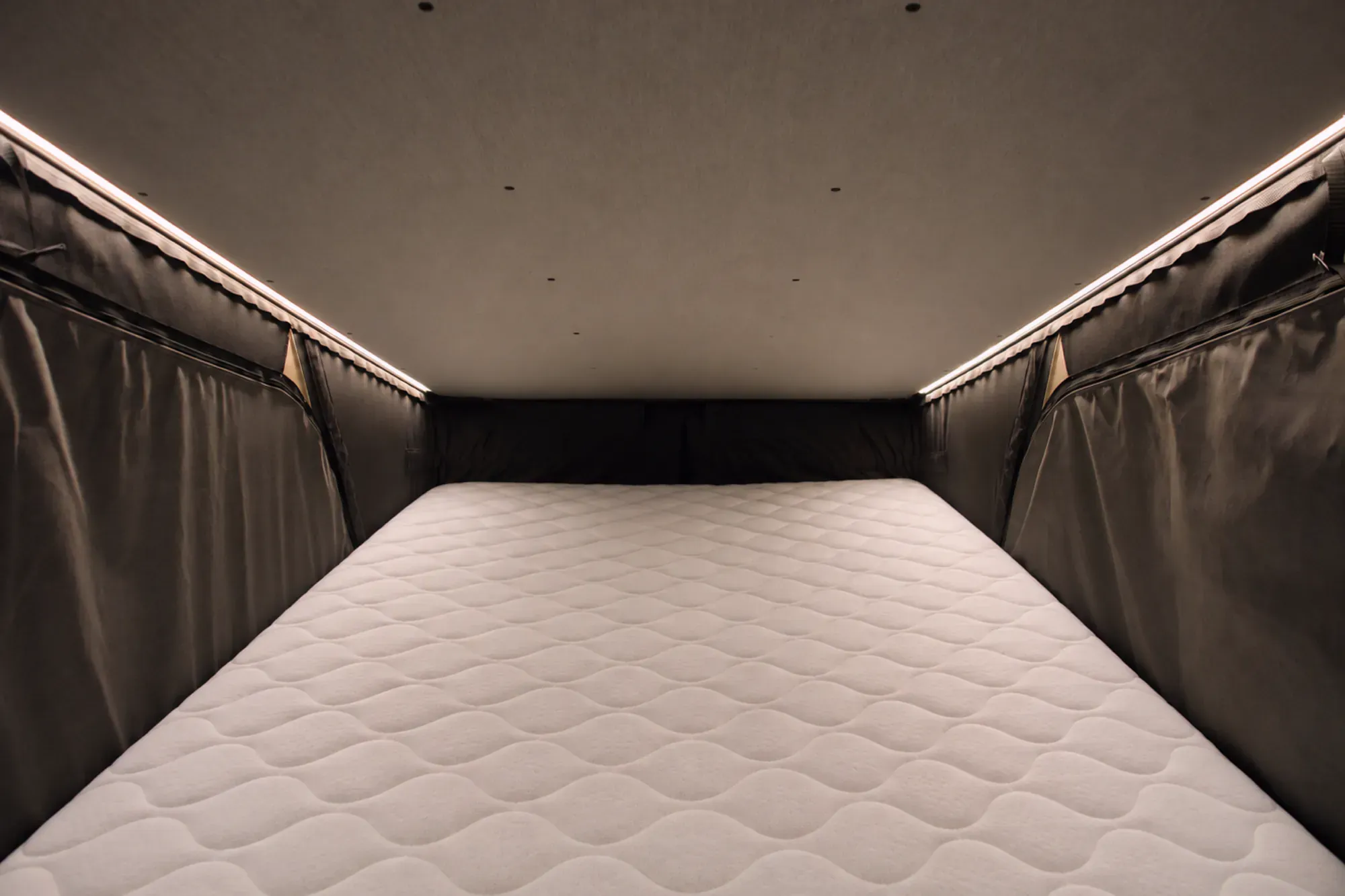
The 125 × 210 cm, 10 cm-thick mattress is made from high-resilience HR foam, also known as cold foam (Kaltschaum). It responds to pressure, adapts to the shape of your body and springs back to its original form once unloaded.
The foam's open-cell structure lets air move through the mattress. Beneath it, a separate 2 cm Airmesh 3D mesh leaves room for air to circulate from below.
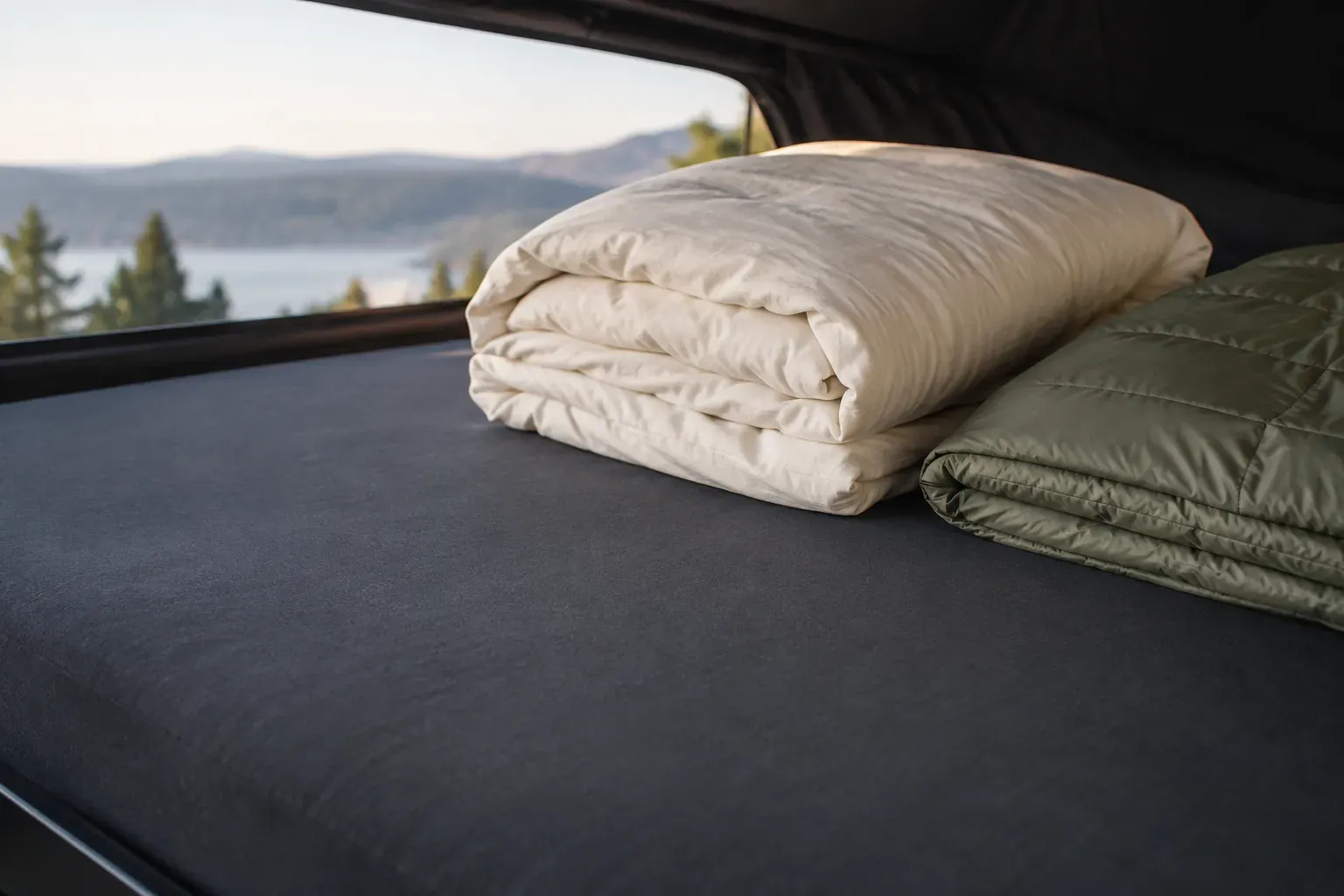
You can close the roof with bedding or sleeping bags left inside. That means less to carry and set up before your next night. Just arrange the bedding so the roof can close properly.
02 / Air and light
An opening front and both sides with mosquito nets, a large glass skylight and light for the evening — plus, in the VAN55 Horizon, an air outlet fed from inside the van.
Air / VAN55
The glass skylight and the opening front and sides with mosquito nets let the breeze through, while in the VAN55 Horizon an outlet fed from the van below airs or heats the space.
Front and rear vents support natural (passive) ventilation of the interior. Covers shield them from driving rain. They complement airing through the skylight and opening sides.
Example airflow with both vents open: from rear to front. The projecting roof edges shield the vents from rain.
Opening front and both sides with mosquito nets.
“Fan” and “Heating” modes — VAN55 Horizon only.
Illustrative diagram. The position of the air outlet is schematic. Airflow direction and heat distribution are examples; in reality they depend on conditions.
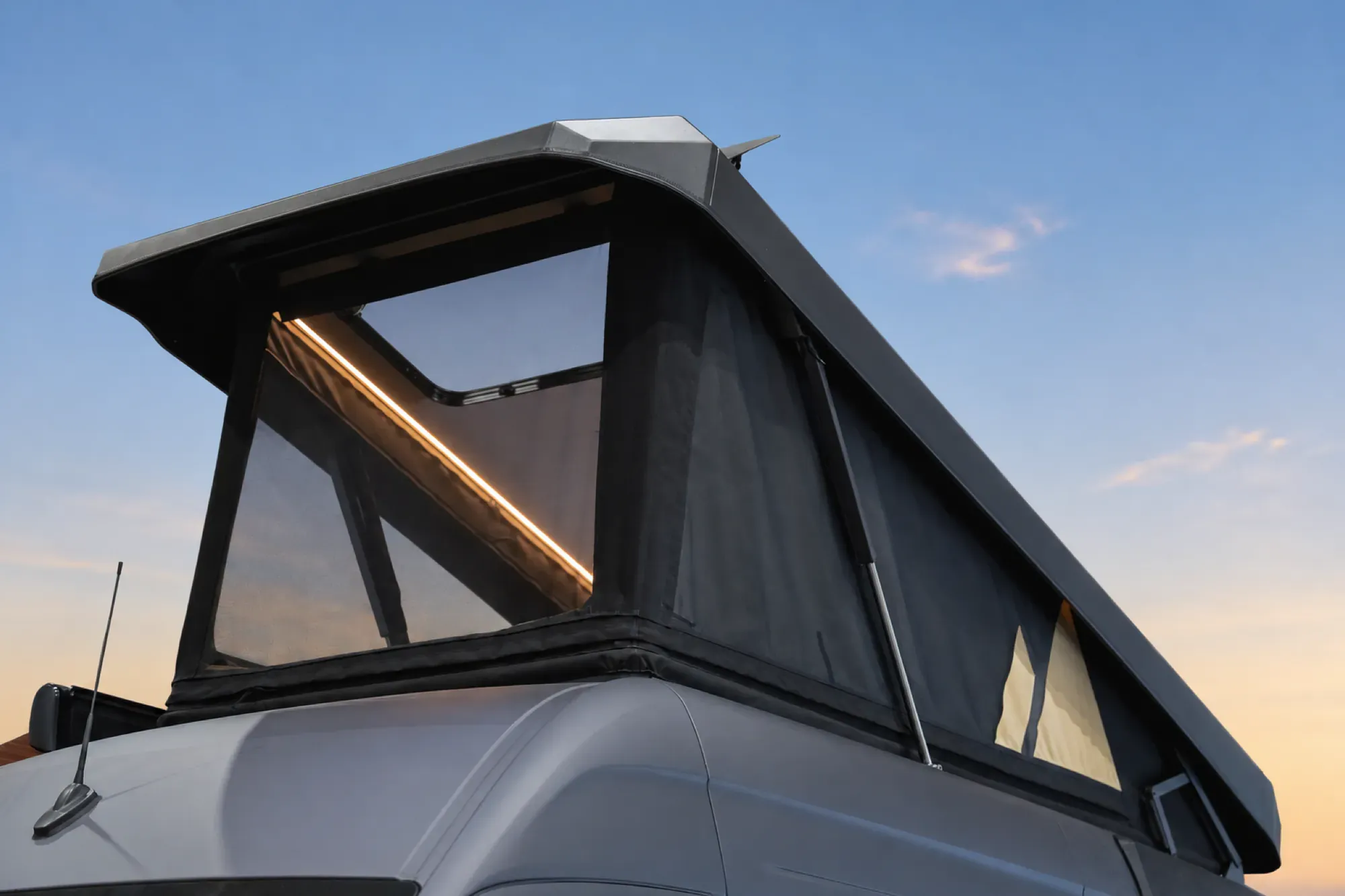
With the front or sides open, fresh air flows straight in. Each of these three sides has a mosquito net, so you can air the space while keeping insects out. The open walls also give you a whole new view of your surroundings.
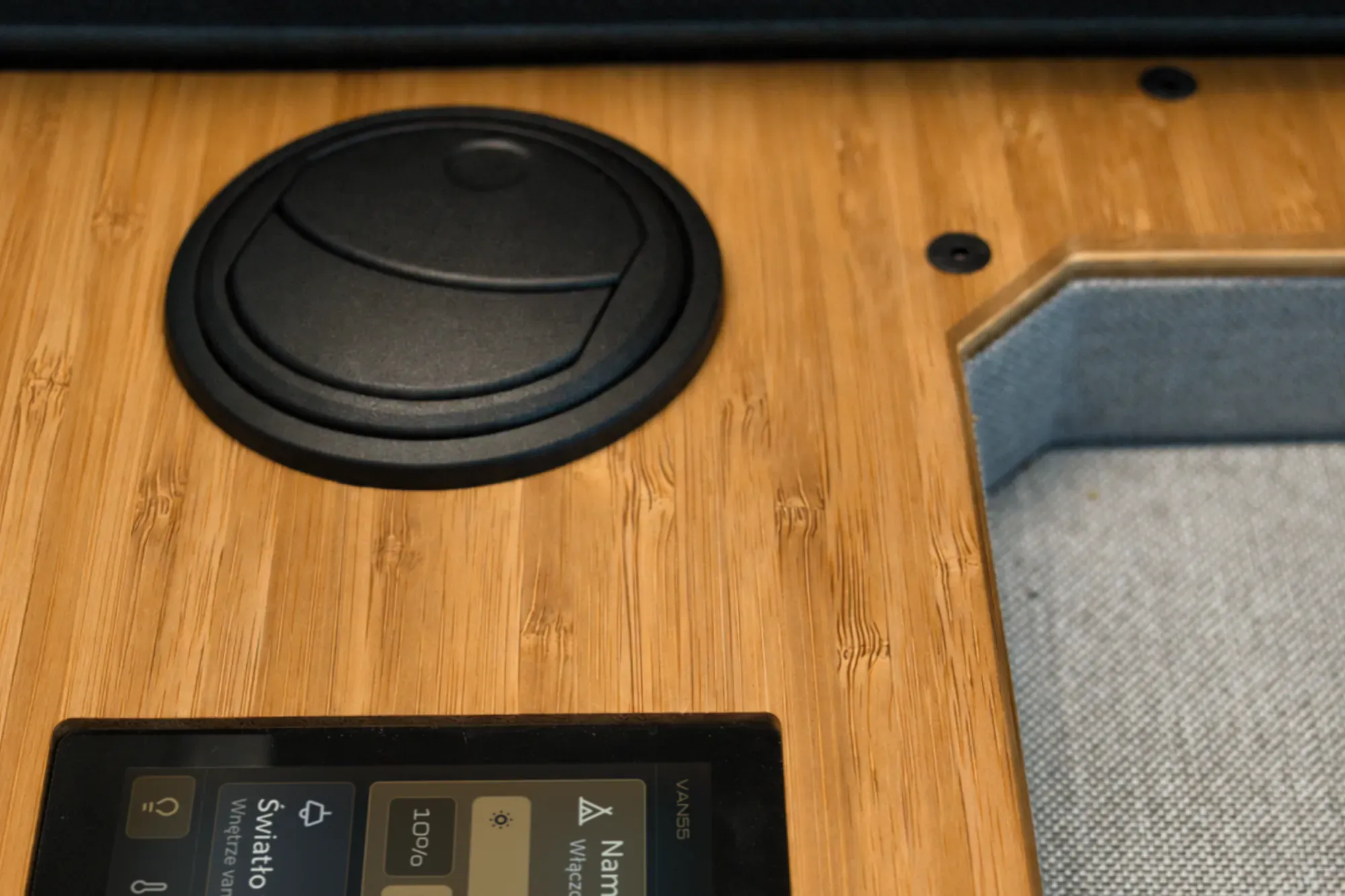
In the VAN55 Horizon vehicle, an outlet in the tent is fed from below by the van's heating system. It works in two modes — with heat and without.
In winter: warm air The vent delivers warm air from the heating system into the sleeping area.
In summer: active ventilation Run the fan on its own, without heating the heat exchanger. The running vent keeps air moving through the roof.
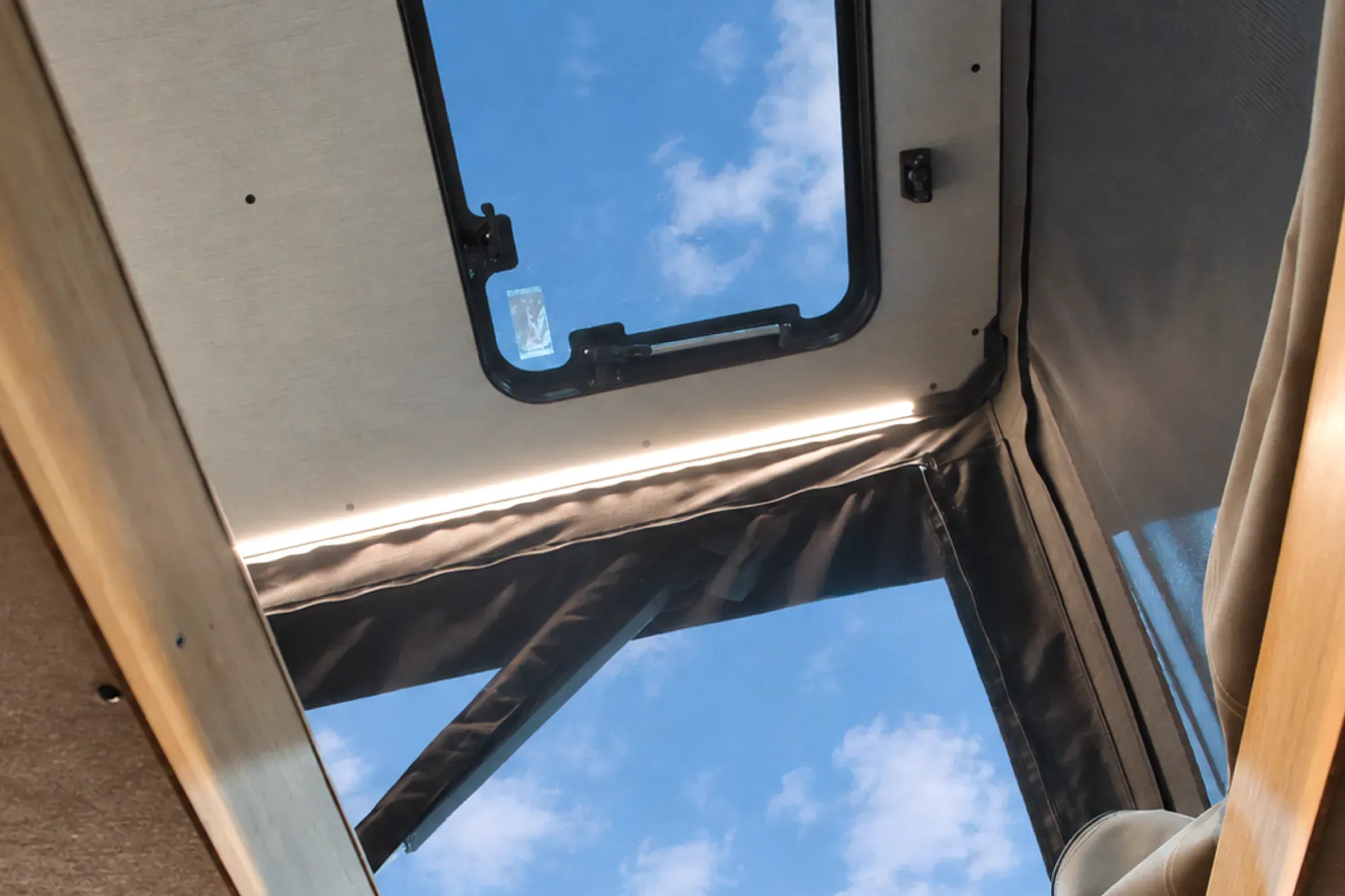
The roof features an opening skylight made of tempered glass. It lets daylight in and keeps you connected to your surroundings even when the fabric windows are closed.
Scratch resistance and lasting clarity The hard surface of glass resists scratching better than uncoated acrylic glazing. Being less prone to fine abrasion marks helps it stay clear.
A surface that stands up to cleaning Glass is more chemically resistant than uncoated acrylic. Choose cleaning products according to the recommendations for the whole window, including the frame and seals.
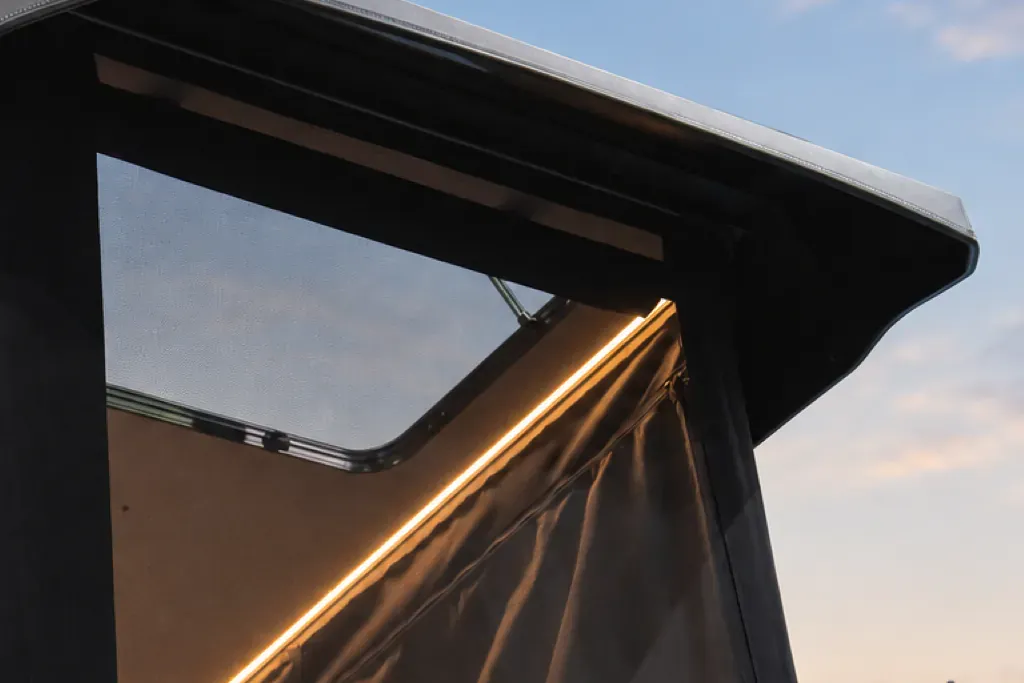
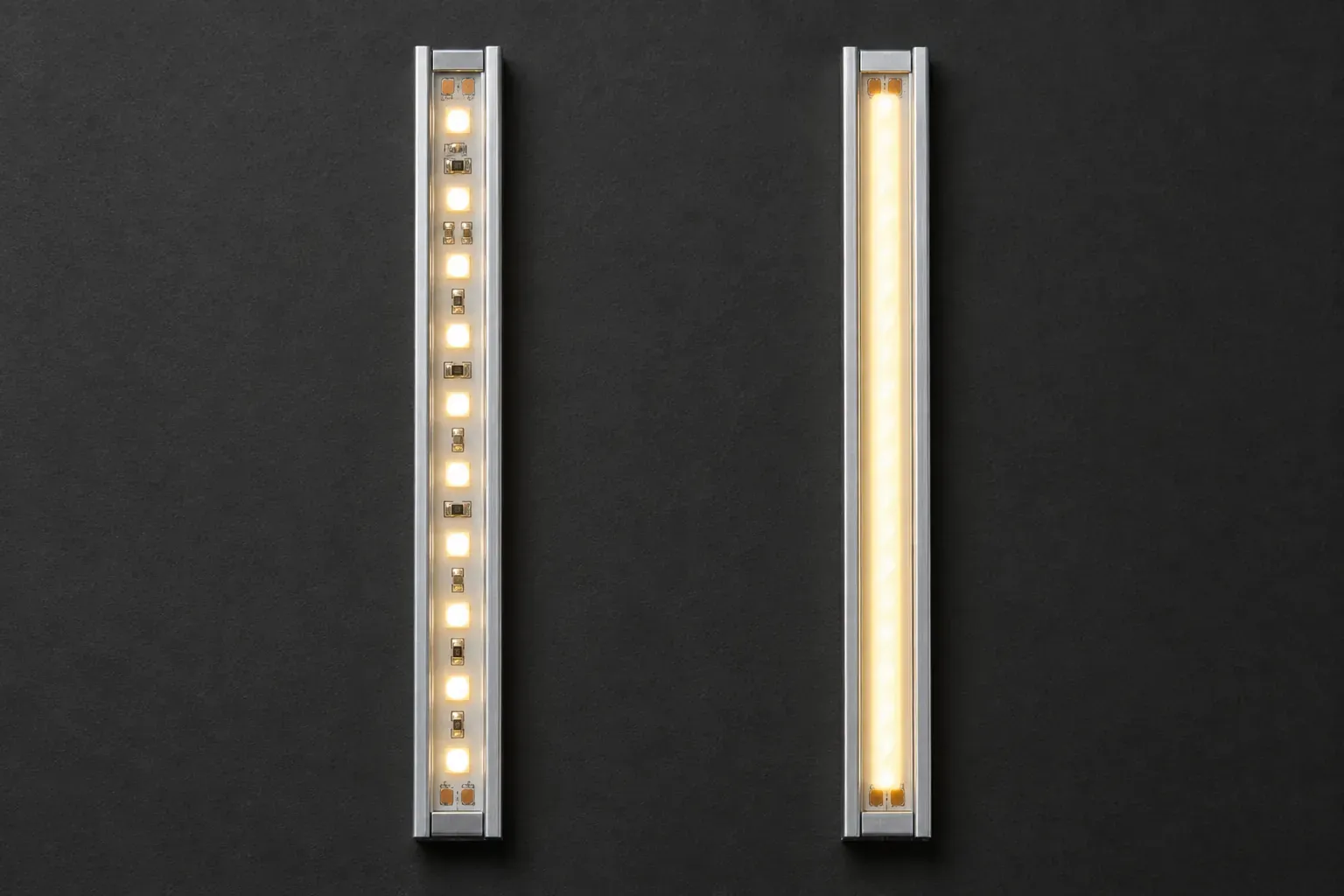
COB LED strips run along both sides of the roof, each 3 m long — 6 m of light in total. As standard we use single-colour-temperature COB — warm white, 3000 K — for a seamless line of light with no visible LED dots. The brightness is dimmable: light up the space or dim it down before you sleep.
Lighting, chosen with care
We wanted a seamless line of light. The illustration shows visible LED dots next to a continuous COB line.
On dotted CCT strips with alternating warm and cool LEDs, lighting just one group can make the gaps visible. For the VAN55 standard we chose COB in a fixed warm white of 3000 K, with dimming.
COB CCT strips also exist. COB describes how the emitter is built; tunable white or colour is a separate feature of the strip and its controller. The illustration compares a single-colour dotted strip with COB; it does not show an alternating CCT layout.
03 / Everyday use
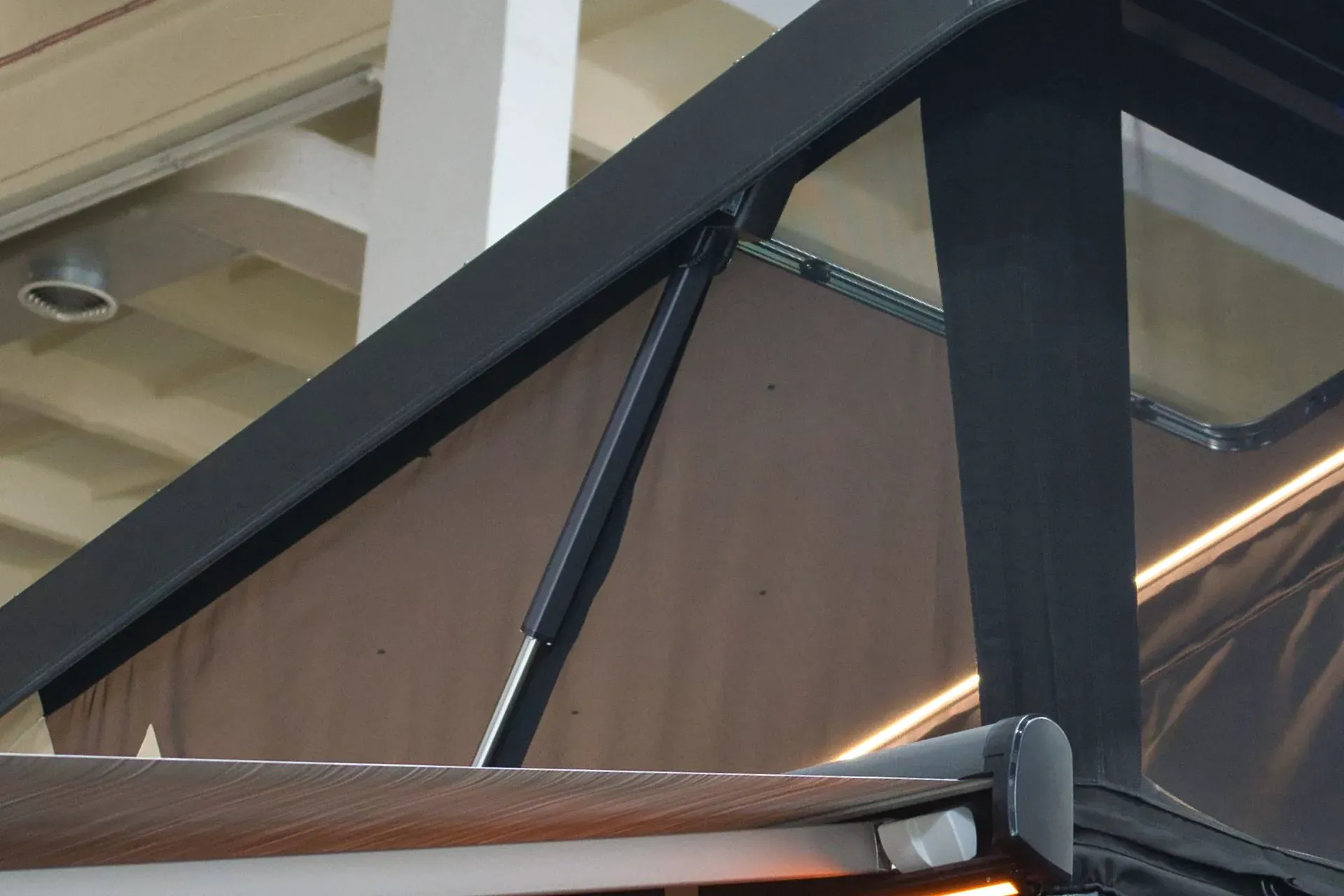
The roof comes in two versions: electric, with actuators, and manual, with gas struts.
Push-button opening
Electric actuators raise and lower the roof.
Dedicated buttons open and close the roof. Optional integration with the cockpit panel is available exclusively in the VAN55 Horizon.
The cockpit in the VAN55 Horizon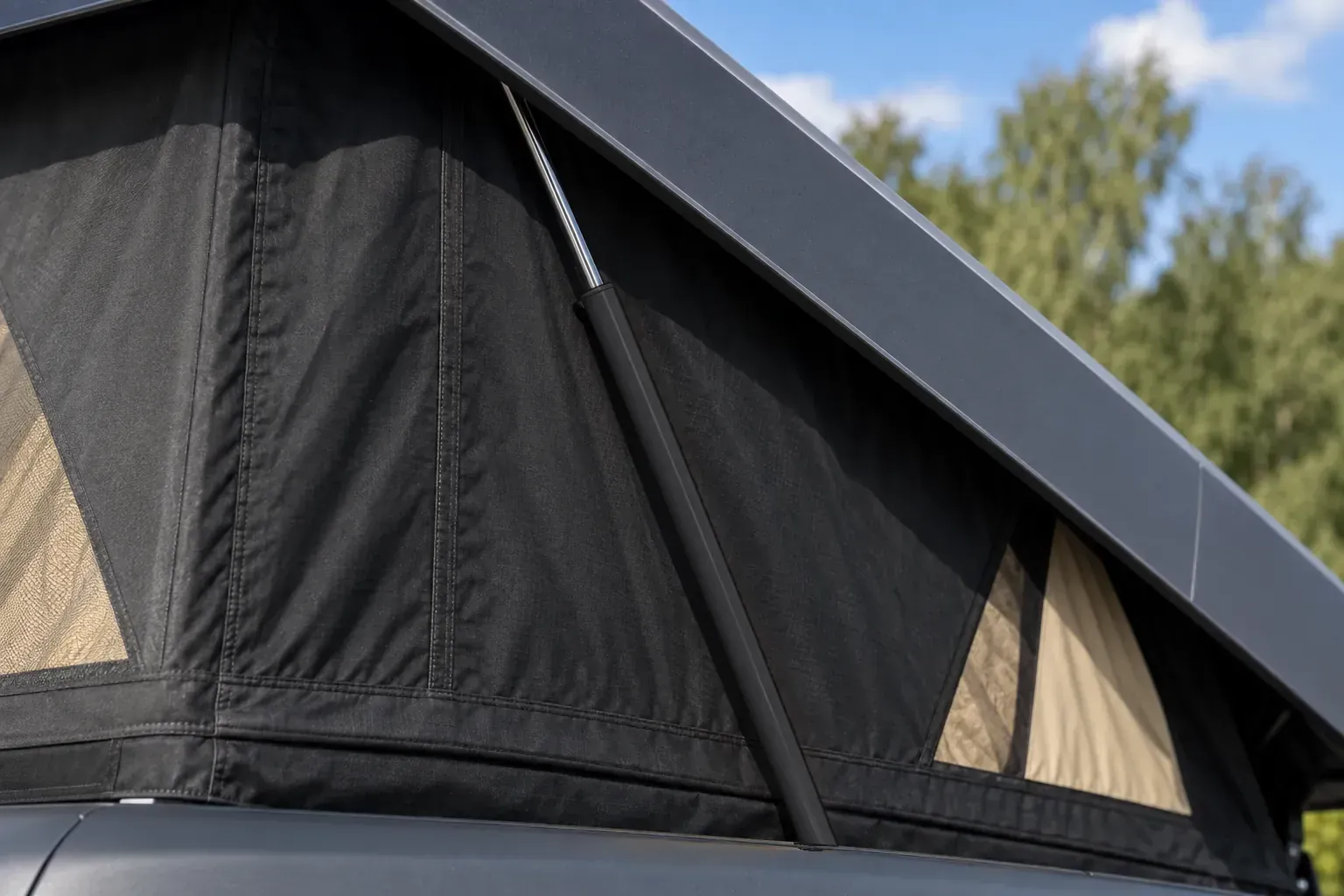
Manual opening
In the manual version you raise the roof by hand, assisted by gas struts.
To close it, climb the ladder, take hold of the handles and pull the roof down until it closes.
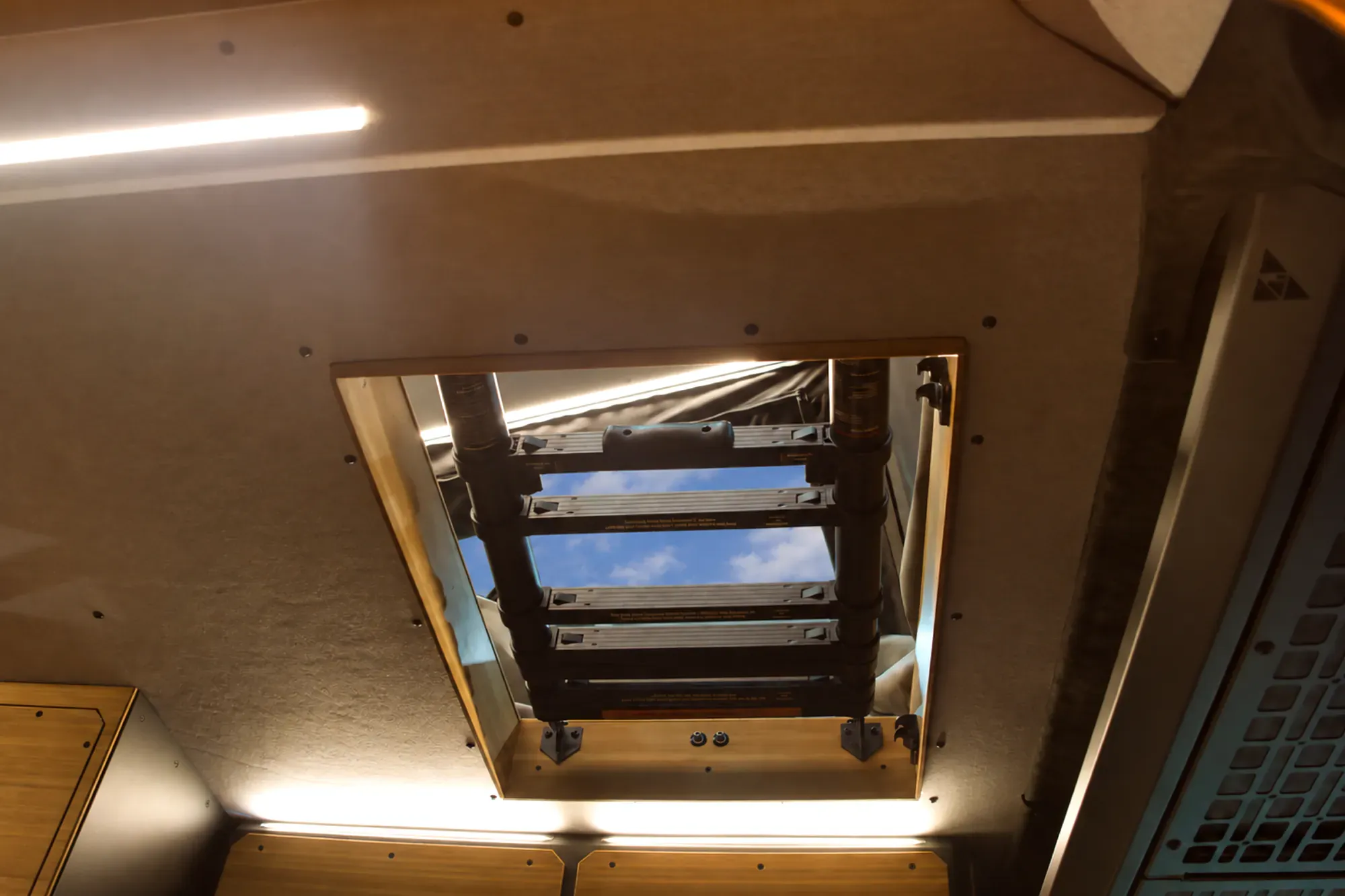
The telescopic ladder is permanently attached to the roof hatch. Once folded, it stays stowed inside the roof, including while you drive. No more hunting for it in the rear garage or carrying it to the entrance.
Control from the sleeping area
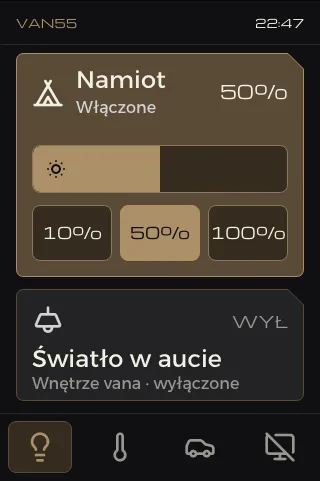
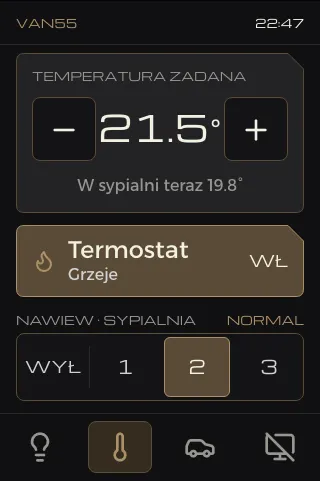
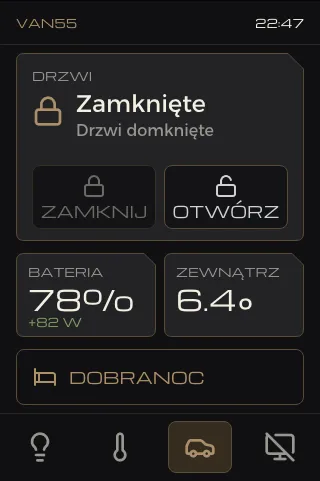

Panel interface preview. Values and states shown are examples.
Optional cockpit module
The optional cockpit module is available exclusively in the VAN55 Horizon. It combines extra storage for personal items with a control panel.
Illustrative diagram: controlling van functions from upstairs too.
Van functions within reach. Icons of control options — not an interface design.
The optional panel in the VAN55 Horizon lets you control selected van functions from the sleeping area. The scope is defined for each configuration.
Depending on the configuration, the panel can control:
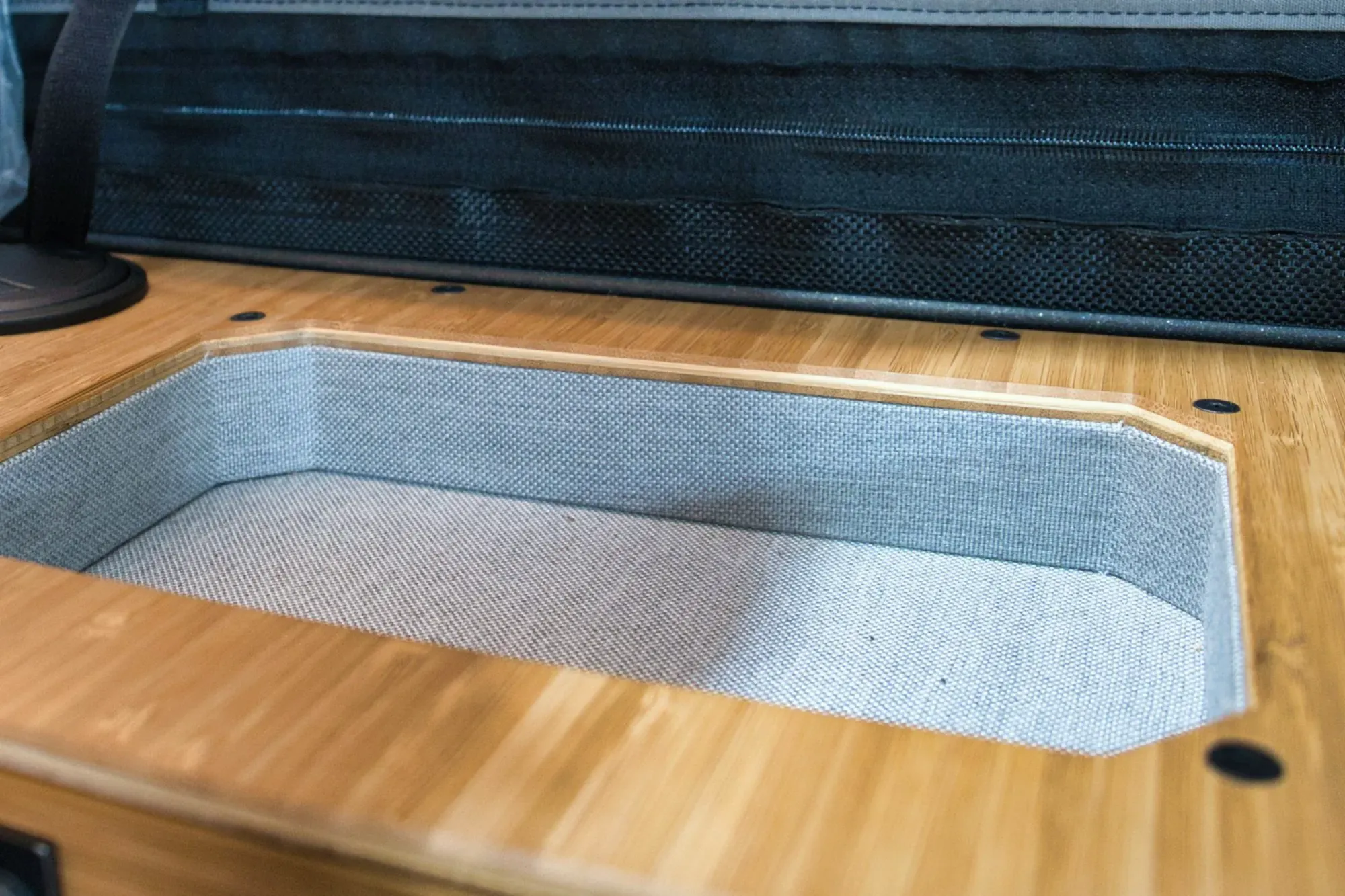
The optional cockpit module, available exclusively in the VAN55 Horizon, holds your phone, glasses and other personal items — so they don't end up on the mattress.
USB-C — charger in the cockpit, available exclusively in the VAN55 Horizon.
In the VAN55 Horizon, the tent cockpit has a USB-C charger and the sleeping area has 230 V sockets. Both are available exclusively in this vehicle.
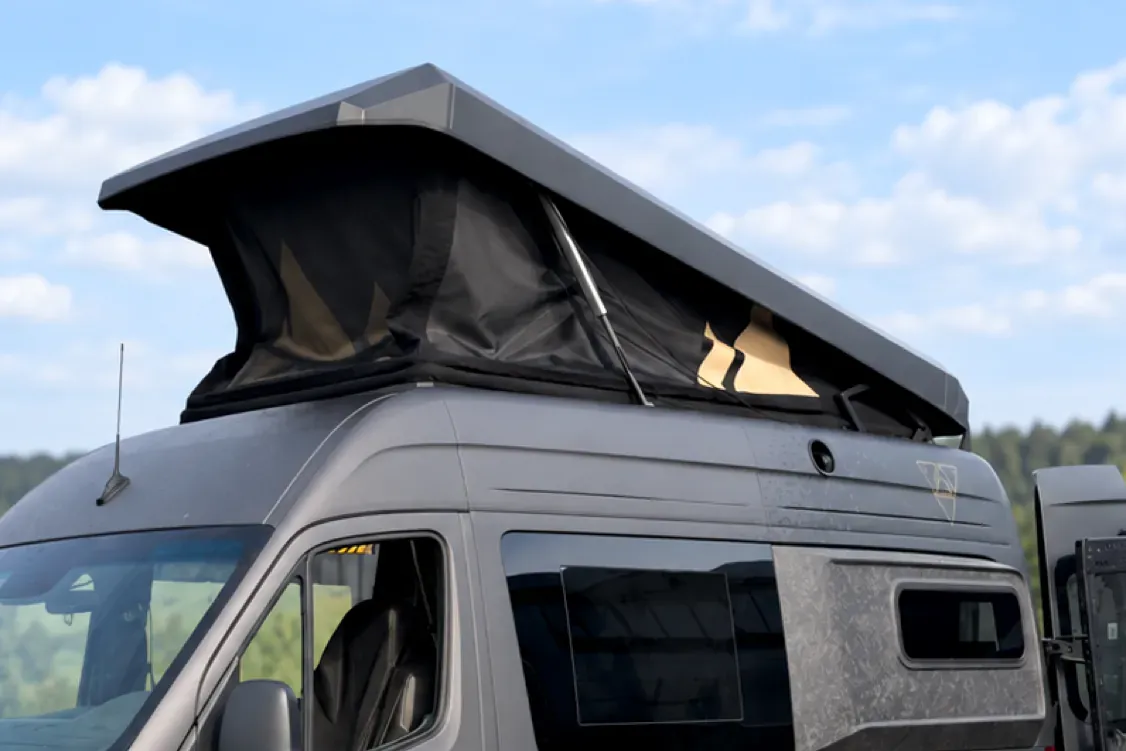
An automatic tuck-in system guides the fabric inside the structure as the roof closes. It reduces the need to tidy the fabric by hand and makes getting ready to drive simpler.
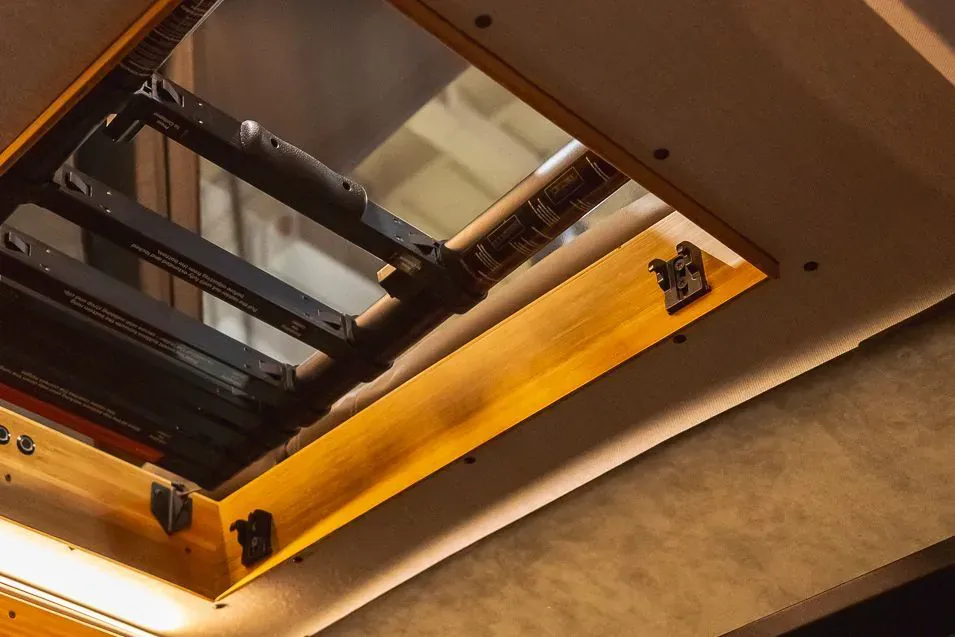
Once folded, the roof is secured by two locks. Their job is to keep it firmly closed while you travel.
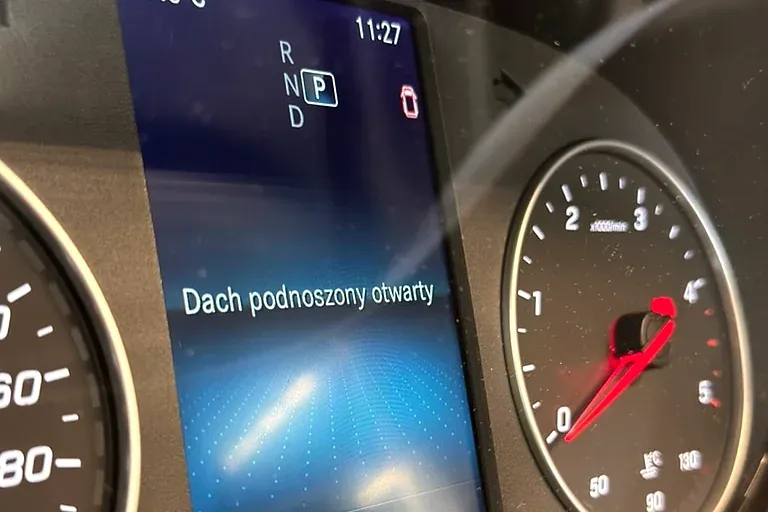
In the VAN55 Horizon, integration with the vehicle's electronics warns the driver before setting off with the roof open.
04 / Construction and materials
An aluminium structure, fabric developed with Marabut and details that keep the fabric taut and the roof weathertight.
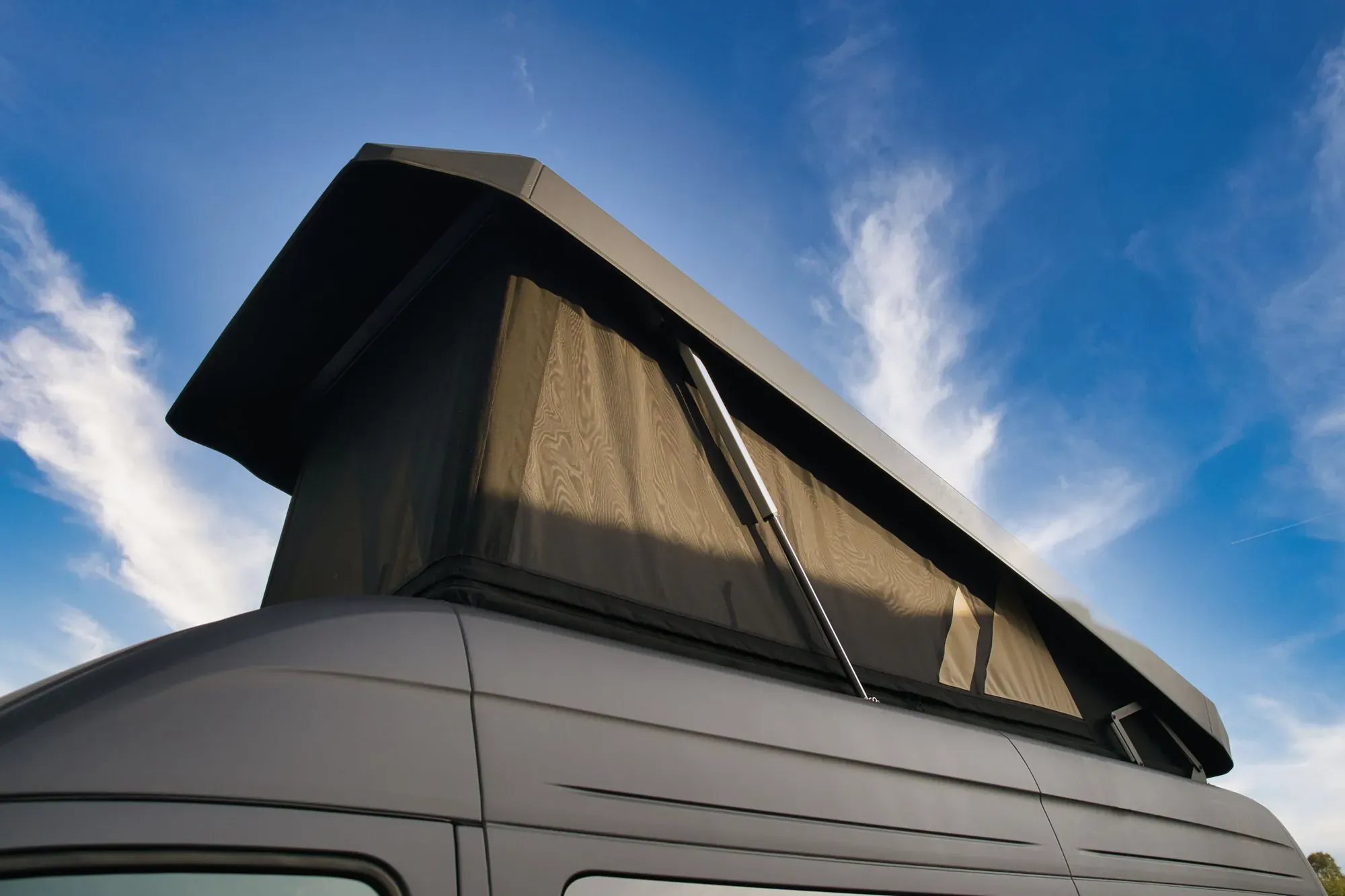
The aluminium shell brings the roof structure and the fabric mounting together into one coherent whole. It is finished in a black, matt, textured powder coat.
Illustrative diagram: three layers and an aluminium honeycomb.
Roof layers and structure. Two facts about the construction — without showing the material layup.
The roof panel has a three-layer construction. Its core is an 18 mm aluminium honeycomb panel.
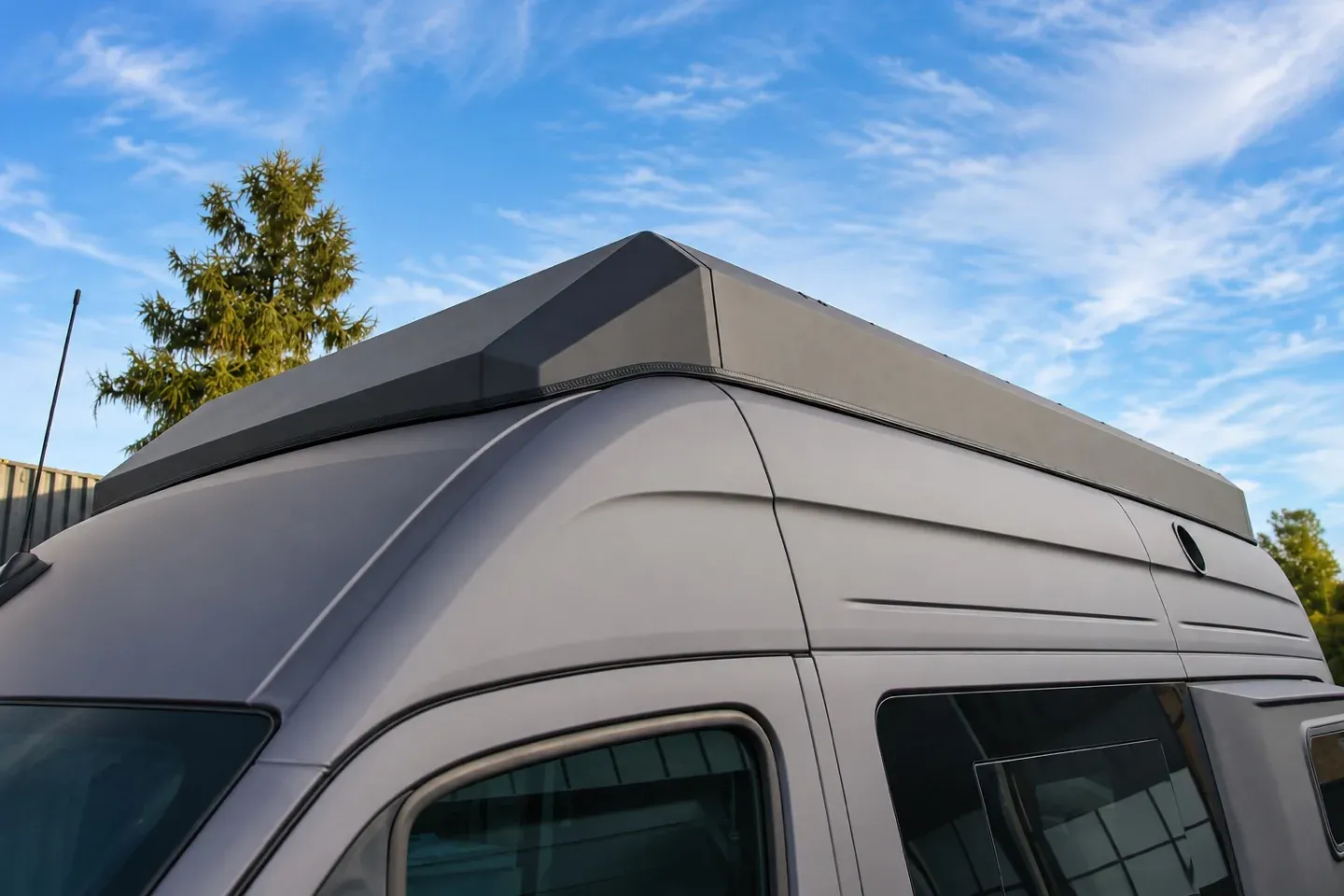
The streamlined shell follows the vehicle's roofline, so the roof and the van read as one. Its aerodynamic shape also reduces wind noise on the move.
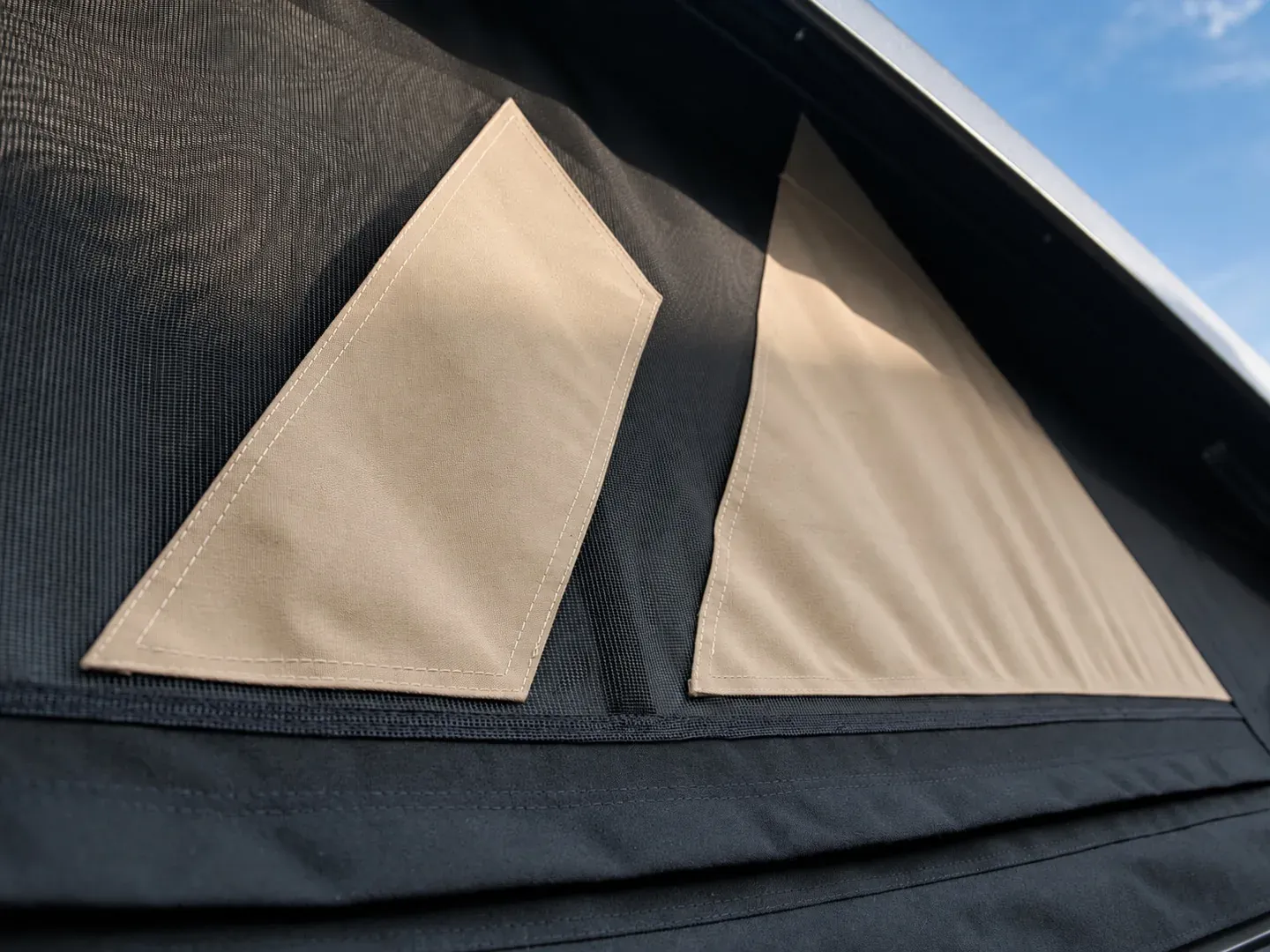
We make the fabric from Sunbrella Plus — a solution-dyed acrylic designed for outdoor covers. A single-sided polyurethane coating and a water-repellent finish help keep water out, while the material stays resistant to UV and fading.
Fabric specifications as stated by the manufacturer; tolerance ±5%. The fabric's water penetration resistance is not a measure of the whole roof's weathertightness.
We developed the VAN55 roof fabric together with Marabut. The Polish manufacturer takes part in its design, sewing and production, bringing more than 30 years of tent-making experience. The brand has been active since 1989.
Illustrative diagram of the keder system: the rail and keder bead holding the fabric.
Keder system. Rail and keder bead. Evenly tensioned, stable fabric.
A keder bead slid into the mounting rail seats the edge of the fabric securely and helps keep the material evenly tensioned.
If needed, the fabric can be removed for servicing without touching the structure.
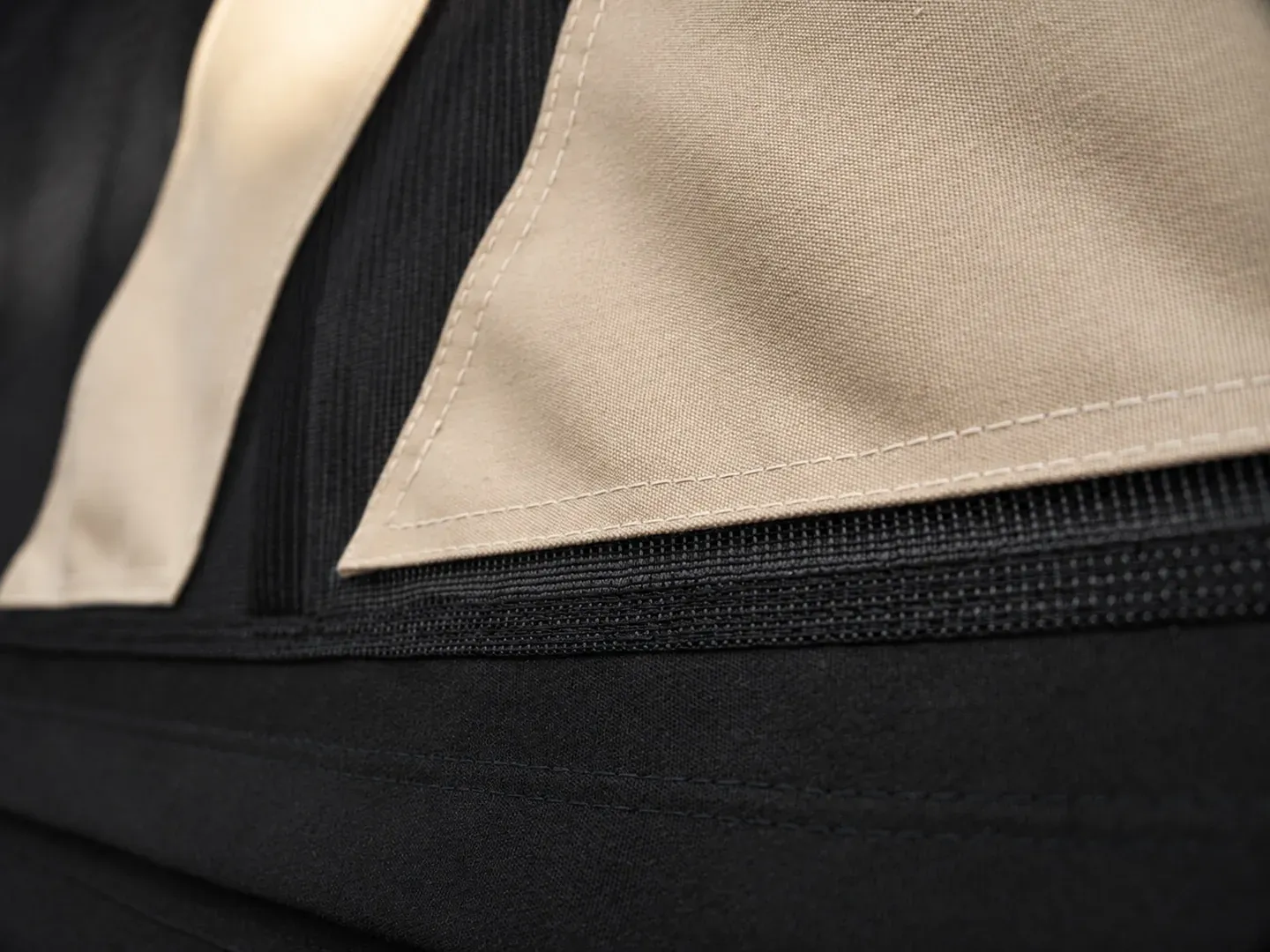
When exposed to moisture, the thread swells and increases in volume. This helps seal the stitch holes in the fabric.
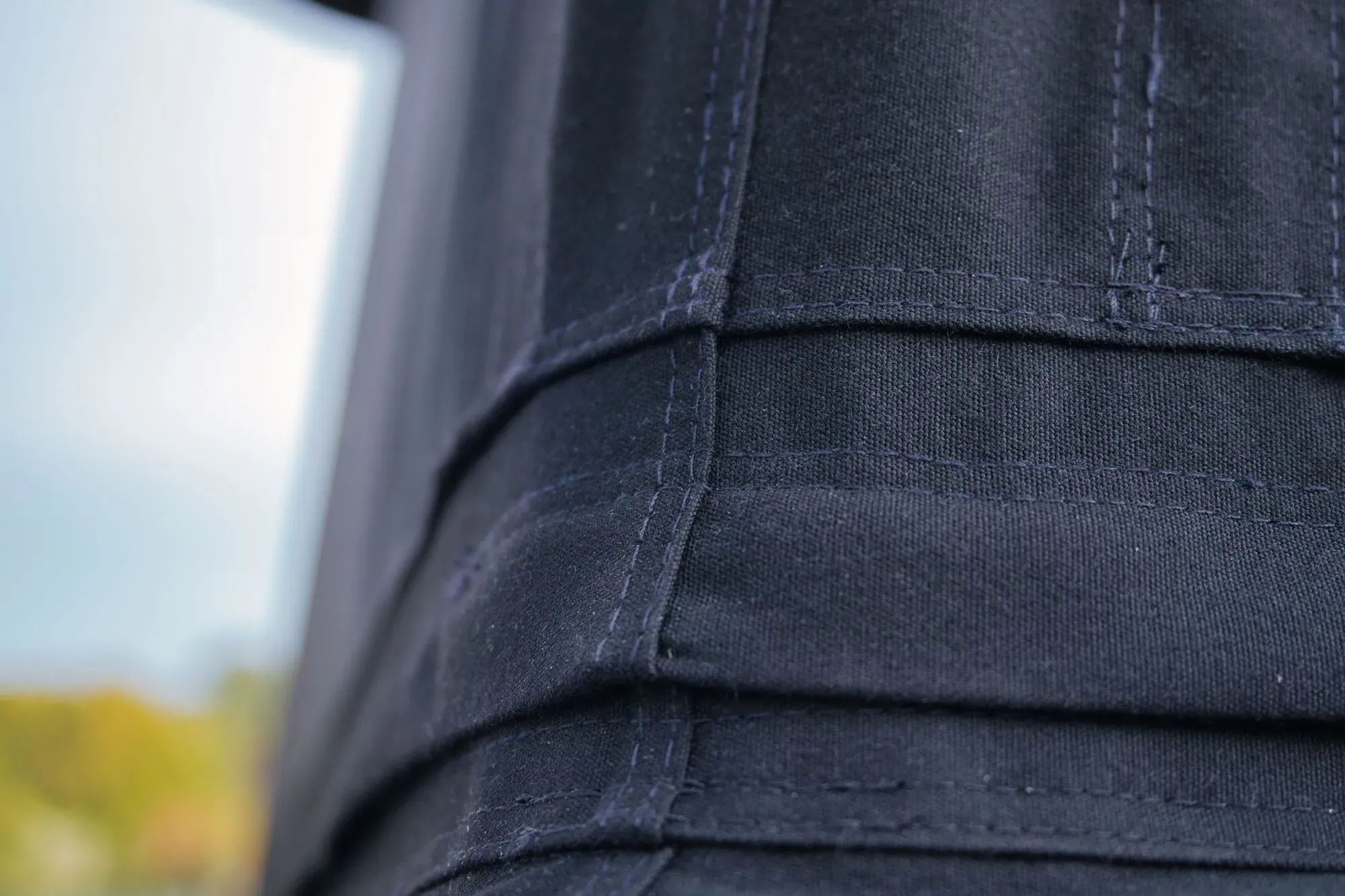
The roof and fabric are designed to channel water outwards and minimise places where it can collect. The drainage layout was designed to avoid water pooling. It is part of what keeps the interior protected from rain. The way the fabric joins the structure protects against leaks where the fabric is attached.
05 / Energy and extra equipment
A solar panel and AirLine rails included, plus optional mounts — from Starlink Mini to a side awning.
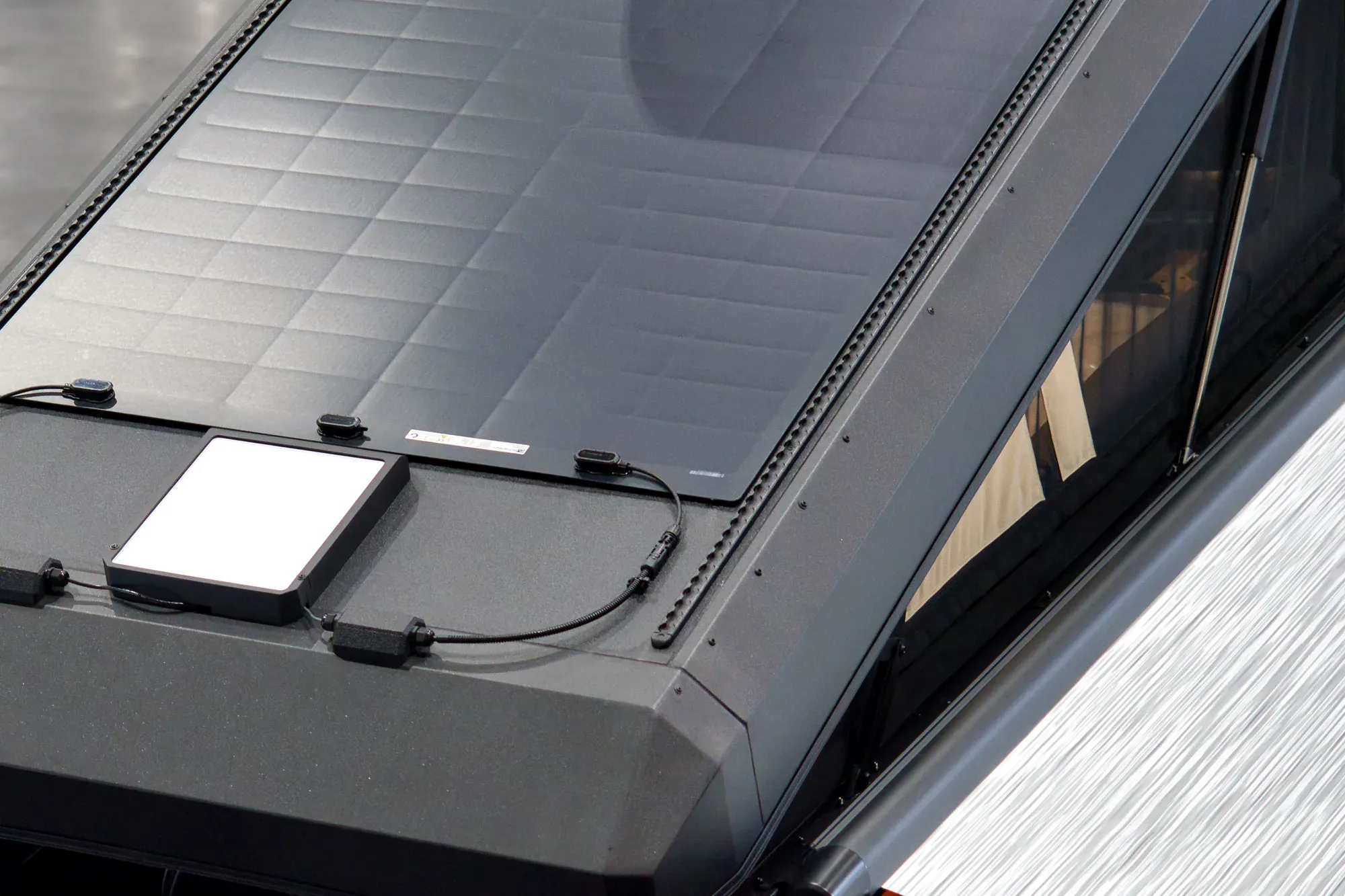
A lightweight 420 W solar panel comes as part of the package. It makes use of the tent roof surface to generate energy for your van.
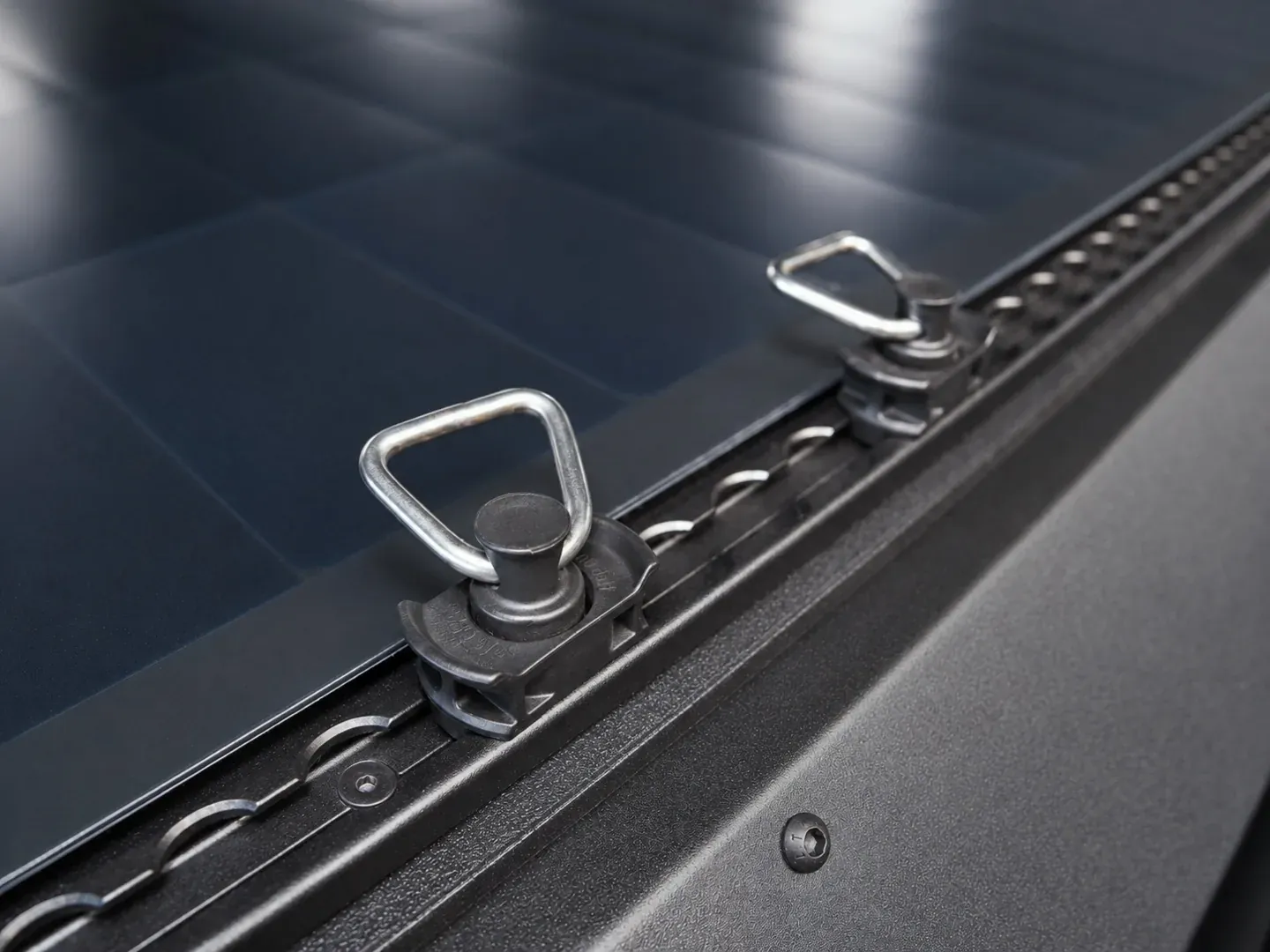
Integrated AirLine rails come included and provide mounting points for additional accessories.
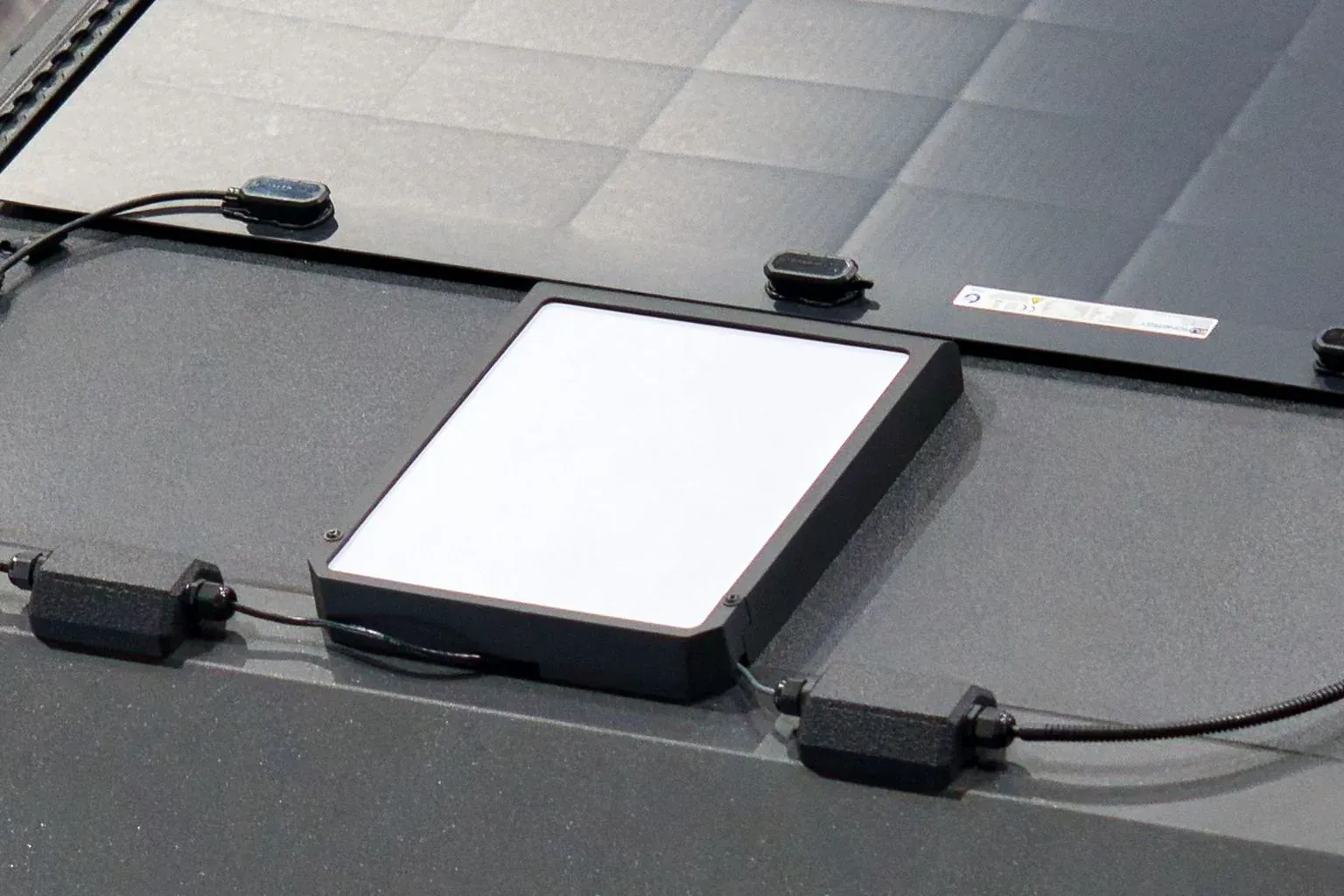
An optional mount lets you install a Starlink Mini terminal.
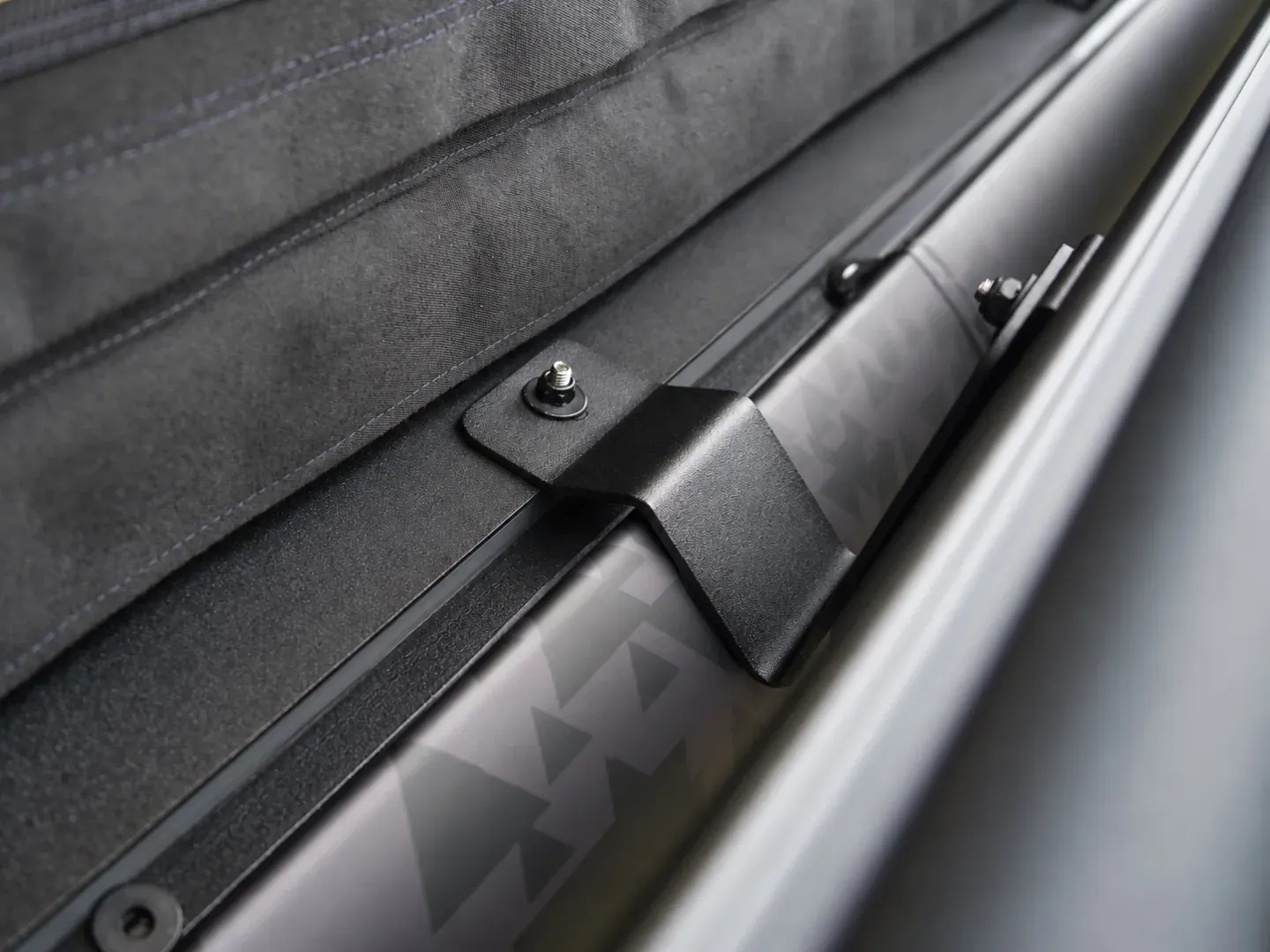
Optional brackets make it easy to fit most side awnings on the market — no extra adapters needed.
06 / Fitment and installation
Vehicle compatibility, the required rails and professional installation — all in one place.
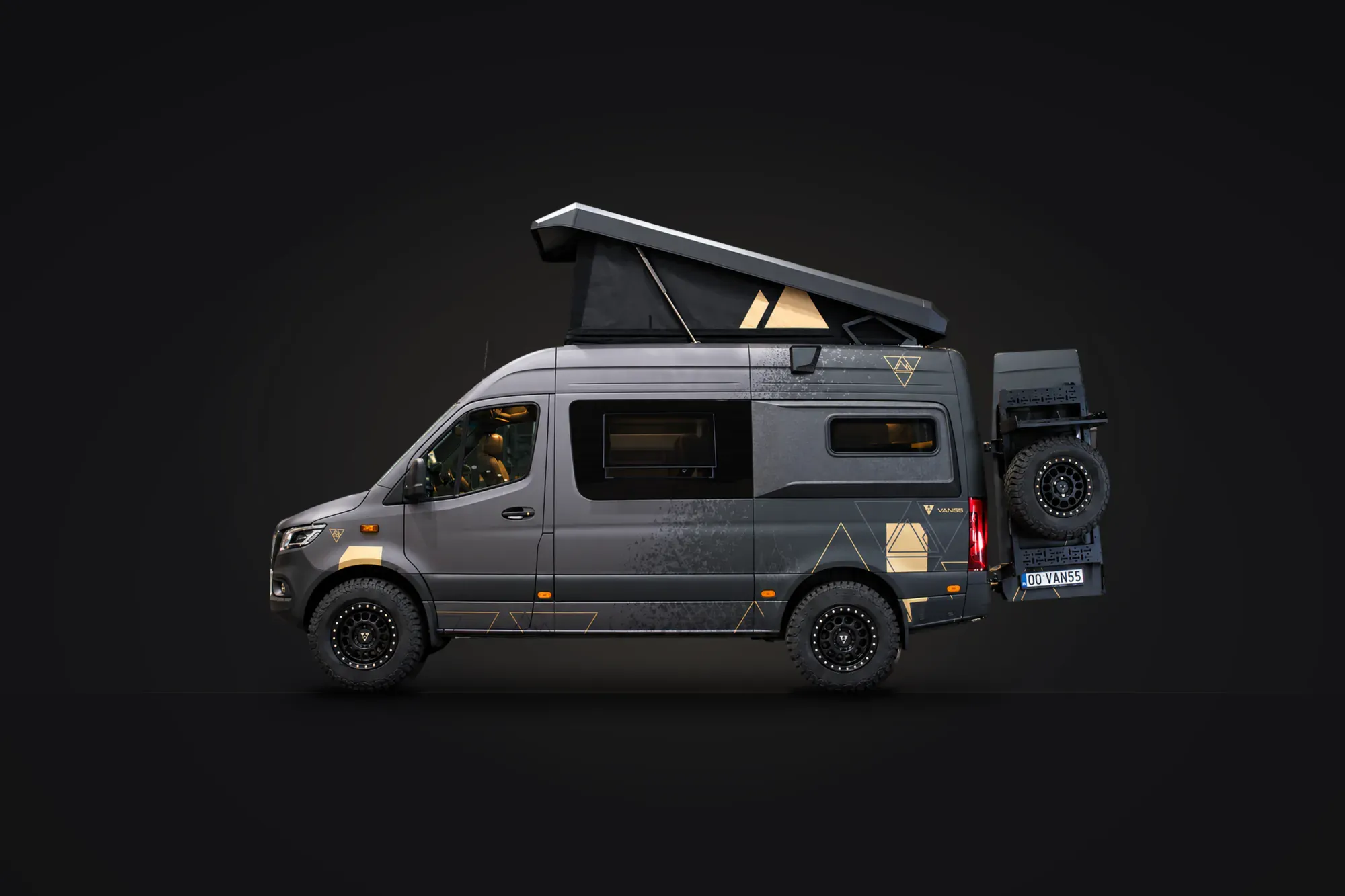
The pop-up roof is compatible with the Mercedes-Benz Sprinter W906 L2H2 and W907 L2H2. Versions for L3H2 and L2H1 bodies are planned for 2027.
We measure from the vehicle roof, because overall height depends on the Sprinter version, drivetrain and suspension. Closed, the tent adds approx. 250 mm. Open, the front edge of the pop-up roof sits approx. 1402 mm above the vehicle roof, while the hinge stays at the rear.
Side view: tent closed and open, dimensions from the vehicle roof
Left side of the van, front on the left, both drawings to the same scale. Illustrative drawing based on the VAN55 Horizon (Mercedes-Benz Sprinter W907 L2H2); dimensions measured from the vehicle roof.
Tent closed
the pop-up roof lies flat on the van — drive and park without setting up
Tent closed: the pop-up roof lies flat on the van — drive and park without setting up. Top of the pop-up roof approx. +250 mm above the vehicle roof.
Tent open
the pop-up roof lifts at the front, hinge at the rear
Tent open: the pop-up roof lifts at the front, hinge at the rear. Front edge of the pop-up roof approx. +1402 mm above the vehicle roof.
Illustrative diagram: mounting to the original rails.
Installation matched to the vehicle. Original rails; mounting to the rails needs no drilling into the roof.
The tent must be mounted to genuine Mercedes-Benz roof rails. Mounting the tent to the rails itself requires no drilling into the roof. If your vehicle doesn't have genuine Mercedes-Benz roof rails, it needs to be retrofitted with them before the tent is installed. The hatch opening with its mounting frame is a separate part of the installation — the frame and its installation are included in the price, and the hatch is how you get into the tent from inside the van.
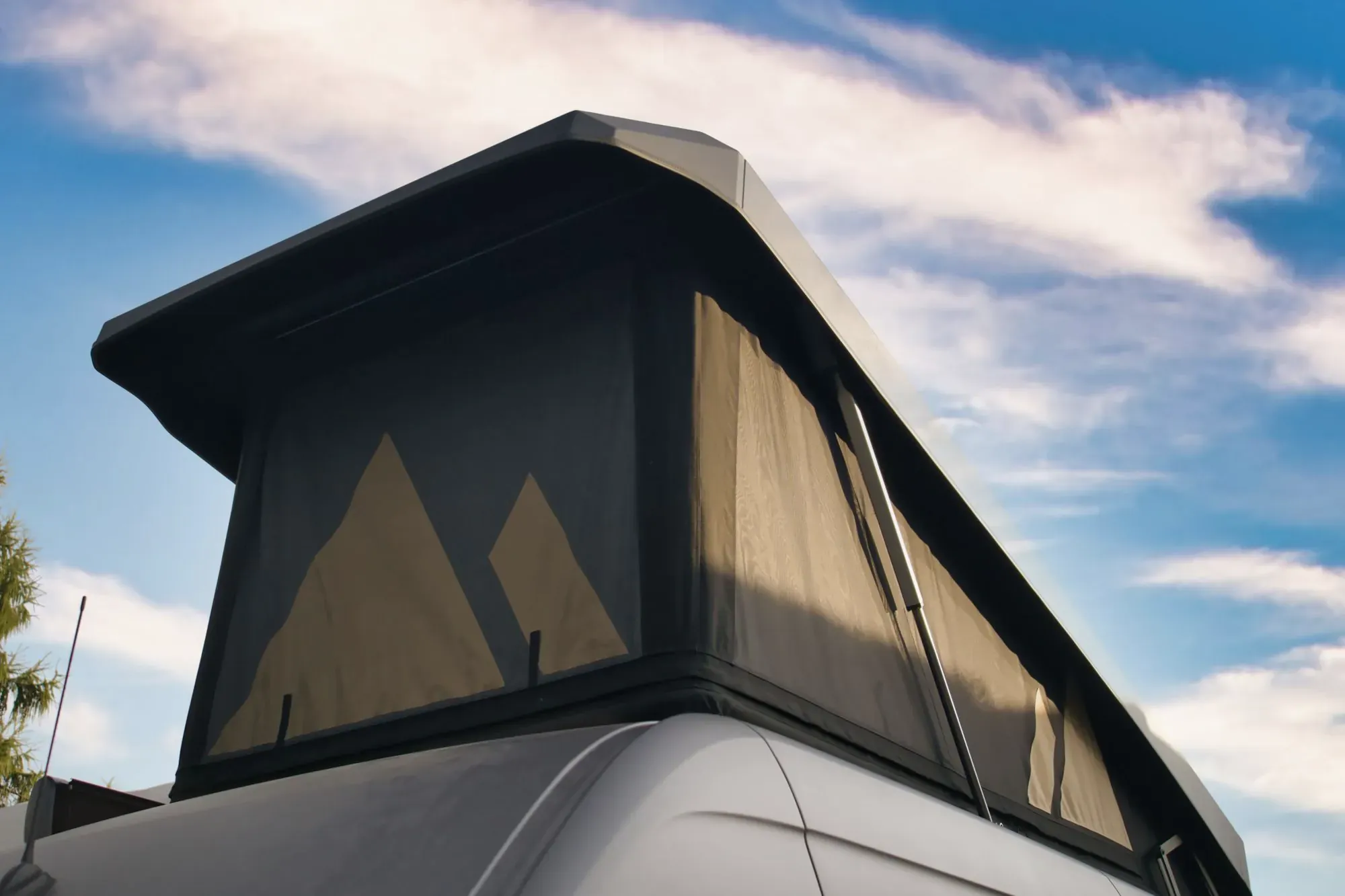
Fitted by trained partners
VAN55 tents are installed exclusively by certified, trained partners. The product is not intended for self-installation.
For a prepared vehicle with genuine Mercedes-Benz roof rails already fitted. Your partner will confirm the schedule once the scope of work is agreed.
The hatch mounting frame and its installation are included in the price. Bamboo hatch trim is available exclusively in the VAN55 Horizon. Retrofitting the van with any missing rails is an earlier step in preparing the vehicle.
Technical specifications
The key information for planning your build. Choose the opening system and equipment to suit your van.
Prepare an enquiry| Construction and materials | |
|---|---|
| Type | Pop-up roof |
| Weight | 90 kg |
| Shell and finish | Aluminium; black, matt, textured powder coat |
| Roof | Three-layer construction; core of 18 mm aluminium honeycomb panel |
| Rear hinge | Scissor hinge, stainless steel; raised rear roof edge and lateral stability |
| Fabric | Sunbrella Plus; 100% solution-dyed acrylic, 320 g/m², single-sided PU coating Sunbrella Plus technical data sheet (PDF) |
| Fabric protection | Water penetration resistance: 1000 mm water column (ISO 811); UPF 50+ Fabric specifications as stated by the manufacturer, tolerance ±5%; they do not define the weathertightness of the whole roof. |
| Fabric design and manufacture | Developed with Marabut — design, sewing and production of the fabric |
| Fabric mounting | Keder system: keder bead in a rail; even tension and removable for servicing |
| Sealing and drainage | Thread that swells with moisture; sealed fabric-to-structure join; drainage that minimises water pooling |
| Interior finish | Sunbrella fabric headliner |
| Bedroom and comfort | |
| Mattress | 125 × 210 cm; 10 cm thick; high-resilience HR foam (cold foam) |
| Layer under the mattress | Separate 2 cm Airmesh 3D mesh for airflow |
| Access and ladder | Hatch from the van's interior included; telescopic ladder permanently in the hatch, stowed inside the roof when folded |
| Hatch trim | Bamboo trim — VAN55 Horizon only |
| Bedding in the closed roof | Bedding or sleeping bags can stay inside, provided they are arranged so the roof closes properly |
| Fabric windows | Three opening sides (front and both sides), each with a mosquito net |
| Skylight | Opening, made of tempered glass |
| Passive ventilation | Front and rear vents with rain covers |
| Air outlet and heating | Outlet from the vehicle's heating system in the tent: warm air or fan without heating — VAN55 Horizon only |
| Operation and power | |
| Opening and closing | Electric — electric actuators; manual — gas struts, closed by pulling the handles down |
| Roof control | Dedicated buttons on the electric version; optional panel integration — VAN55 Horizon only |
| Folding and securing | Automatic fabric tuck-in when closing; two locks for travel |
| Lighting | 2 side COB LED strips, 3 m each (6 m in total); warm white 3000 K, dimmable |
| Solar panel | 420 W — included |
| Cockpit and USB-C | Optional control panel with storage and USB-C charger; functions depend on configuration — VAN55 Horizon only |
| 230 V power | Sockets in the sleeping area — VAN55 Horizon only |
| Pre-departure warning | Open-roof warning — VAN55 Horizon only |
| Fitment and installation | |
| Compatibility | Mercedes-Benz Sprinter W906 L2H2 and W907 L2H2 |
| Planned versions | L3H2 and L2H1 — planned for 2027 |
| Vehicle mounting | Genuine Mercedes-Benz roof rails required; if missing, the van needs to be retrofitted with them before the tent is installed. Tent mounted to the rails with no drilling into the roof; the hatch opening with its mounting frame is a separate part of the installation (frame and installation included in the price) |
| Installation | Certified, trained partners only; typically 2 working days for a prepared vehicle with rails fitted |
| Accessory mounting | AirLine rails (included); optional: Starlink Mini mount and brackets for most side awnings on the market, no extra adapters needed |
Good to know
Answers to questions about everyday use, equipment and installation.
No. VAN55 pop-up roofs are installed exclusively by certified, trained installation partners.
Yes, but first the van needs to be retrofitted with genuine Mercedes-Benz roof rails. The rails must be in place before the tent is installed.
Typically 2 working days for a prepared vehicle with genuine Mercedes-Benz roof rails already fitted. Your partner will confirm the schedule once the scope of work is agreed.
Yes, the design lets you leave bedding or sleeping bags inside when closing. Their volume and arrangement must allow the roof to close properly.
Yes. A custom upgrade to CCT (warm–cool white), RGB, RGBW or RGBWW is possible, with a suitably matched controller and wiring. COB CCT strips also exist. The standard set-up has a single colour temperature.
The package includes a 10 cm HR mattress with a separate 2 cm Airmesh 3D mesh, a telescopic ladder permanently attached in the hatch, the access hatch, a lightweight 420 W solar panel, integrated AirLine rails and two 3 m side COB LED strips in warm white (3000 K) with adjustable brightness.
Yes. If needed, it can be taken off for servicing without touching the structure.
Your van. Extra space.
Gather your vehicle details and describe your build. It's the starting point for choosing the roof, equipment and scope of installation.
Thank you
Thank you for your pop-up roof enquiry. We'll get back to you within two working days.
Give us a call — we will help you choose the roof and plan the installation date.
We'd like to hear from installation partners. In your enquiry, tell us about your workshop, its location and your experience in van conversions.